

If you've ever picked up a coin that looked suspiciously shiny for its age, you've probably already sensed something was off. That gut feeling? It's usually right. Cleaned coins are one of the most common issues collectors run into — whether they're browsing a flea market, shopping online, or digging through an inherited collection. Knowing how to spot them can save you from making expensive mistakes.
Why Cleaning a Coin Is Such a Big Deal
Here's the thing most beginners don't realize: cleaning a coin almost always destroys value, even when it's done with the best intentions.
Coins develop a natural layer over time called patina or toning. This isn't dirt — it's actually a sign of age and authenticity. Serious collectors and grading services like PCGS and NGC treat original surface condition as one of the most important factors when evaluating a coin. Once that surface has been altered, there's no going back. A coin that might have graded AU-55 can drop to a "details" grade — meaning it gets flagged as cleaned — and that can cut the value in half or worse.
People clean coins for all kinds of reasons. Sometimes a well-meaning grandparent polished grandpa's old silver dollars so they'd "look nice." Sometimes sellers try to make worn coins appear more appealing. Either way, the result is the same: a coin that looks brighter than it should, but is worth less than it could be.

The Most Common Signs a Coin Has Been Cleaned
1. Unnatural Brightness or Luster
Old coins should not look like they just came out of a mint. If a silver coin from the 1800s looks almost mirror-bright, that's a red flag. The same goes for copper coins that look orange-pink instead of having the deep brown tone they'd naturally develop over decades.
Natural mint luster on older coins has a soft, cartwheel-like flow when you tilt it under light. Cleaned coins tend to look flat or overly reflective in a way that doesn't match the coin's age.
2. Hairlines
This is one of the biggest telltale signs. When someone wipes or polishes a coin — even with a soft cloth — they leave behind thousands of tiny scratches called hairlines. These run in the same direction as the wiping motion and create a distinctive pattern under good lighting.
Hold the coin at an angle under a direct light source and look across the surface. On a genuine uncirculated coin, the fields (flat background areas) should be clean and smooth. If you see a web of fine lines going in the same direction, it's been wiped.
3. Missing Detail in the Recessed Areas
Many cleaning methods — especially dipping in chemical solutions — strip away surface material uniformly. But they can also eat into the recessed details of a design over time or change the color contrast between the high points and low areas. On a naturally toned coin, the low areas typically hold more toning than the high points. On a chemically cleaned coin, everything looks oddly uniform.
4. Unusual or Blotchy Toning
Not all toning is original. Sometimes sellers try to "re-tone" a cleaned coin artificially to hide the evidence. The problem is that artificial toning tends to look uneven, overly vivid, or patchy — especially in the recessed areas. Genuine toning builds up gradually and tends to look more even and mellow, with colors that blend naturally.
If toning looks like it was applied (which it was), it probably was.
5. The Coin Feels Different
This one's harder to quantify, but experienced collectors will tell you that cleaned coins often just feel wrong. The surfaces seem too smooth, too flat. The details lack the sharp, natural crispness of an untouched coin.
Related Reading: Coin Microscope vs. Handheld Magnifier: Which Is Better for Coin Collecting?

How to Get a Better Look
A lot of cleaning damage is subtle, especially on coins that were lightly dipped rather than aggressively polished. This is where magnification becomes your best friend.
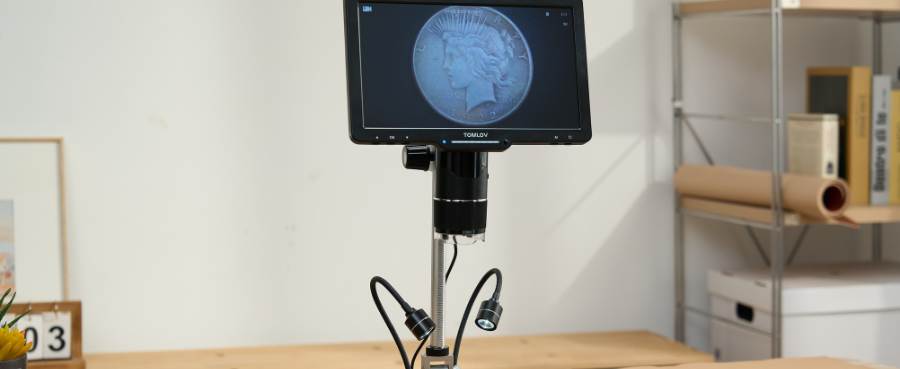
A good loupe — 5x to 10x — will reveal hairlines that are completely invisible to the naked eye. For anything more serious, using a dedicated coin microscope makes a huge difference. You can examine hairlines, surface texture, and the condition of individual design elements in a level of detail that a loupe simply can't match. Many serious hobbyists consider it an essential part of their toolkit, especially when evaluating higher-value coins.
Lighting matters too. Use a single-point light source and tilt the coin slowly as you examine it. The way light moves across the surface will reveal a lot more than you'd see under flat, even lighting.
What About "Dipped" Coins?
Dipping is technically a form of cleaning, but it's more nuanced than scrubbing. Many coins — including a huge percentage of coins in certified holders — have been lightly dipped at some point. When done carefully and only once, a light dip can remove unattractive toning without leaving obvious hairlines.
The problem is when dipping is overdone. Over-dipped coins look washed out, with a "white" or bleached appearance that experienced collectors immediately recognize. They've lost their natural skin and will often re-tone in unpleasant ways over time.
Final Thoughts
Spotting a cleaned coin gets easier with experience. The more original coins you handle, the more quickly you'll recognize when something looks off. Start by comparing coins you know are genuine with ones you suspect have been altered — the differences become obvious fast.
Take your time, use good lighting, invest in decent magnification, and trust your instincts. In coin collecting, the details really do make all the difference.

Commenta
Nota che i commenti devono essere approvati prima di essere pubblicati.
Questo sito è protetto da hCaptcha e applica le Norme sulla privacy e i Termini di servizio di hCaptcha.