
Table of Contents
Microscopes use five main light sources: incandescent, halogen, LED, arc lamps, and fluorescent illuminators. LED is the modern default for classroom and routine lab work, halogen suits color-accurate imaging, and arc lamps handle fluorescence microscopy. The right choice depends on your sample and what you need to see.
Why does the light source matter?
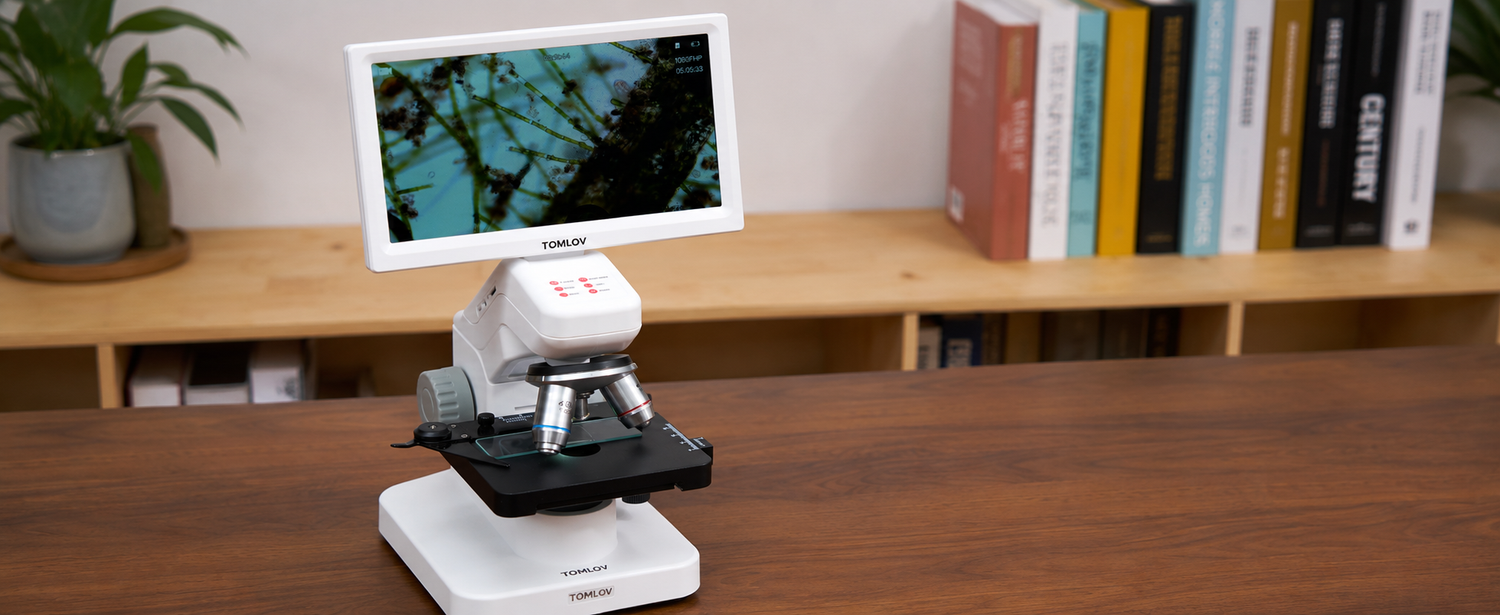
The image you see through a microscope is built from light passing through or bouncing off your specimen. If that light is too dim, the wrong color temperature, or unevenly distributed, the image suffers. Fine structures wash out, contrast drops, and photographs come out flat. This is why the digital microscope models pair a quality sensor with carefully matched LED illumination, since the lighting determines what the sensor can actually capture.
It also affects the specimen itself. Some light sources generate heat, which can damage living samples or dry out wet mounts faster than you'd expect. Others emit specific wavelengths needed for techniques like fluorescence, where the wrong light source means seeing nothing at all. Choosing well isn't a minor detail; it shapes what's actually visible.
How does microscope lighting work?
Most compound microscopes use transmitted light — the bulb sits below the stage and shines up through the specimen, the condenser focuses the beam, and the objective lens collects what passes through. Stereo and inspection microscopes more often use reflected light, where the source illuminates the surface of the sample from above. Either way, the light travels through a series of lenses and apertures before reaching your eye or camera sensor.
The condenser and diaphragm control how the light hits the specimen. A wide-open diaphragm floods the field with brightness but reduces contrast; closing it down sharpens detail at the cost of light. Getting these adjustments right matters as much as the light source itself.
 What are the main types of light sources?
Incandescent lamps
The oldest microscope light source — a tungsten filament inside a glass bulb. Incandescent lamps produce a warm, yellowish light that's easy on the eyes but not ideal for color-accurate work or photography. They also generate significant heat and burn out relatively quickly. You'll still find them on older or very inexpensive microscopes, but newer models have largely moved on.
Halogen lamps
A refined version of the incandescent design. Halogen bulbs contain a small amount of halogen gas, which lets the filament burn hotter and brighter while lasting longer. The light is whiter and more intense than standard incandescent, making halogen a popular choice for laboratory microscopes where color accuracy matters. The downside is heat — halogen lamps run hot enough to affect heat-sensitive samples and require good ventilation.
LED lights
Light-emitting diodes (LEDs) have become the default light source for most modern microscopes. They produce a bright, cool white light, last tens of thousands of hours, and consume very little power. LEDs generate far less heat at the specimen than incandescent or halogen lamps. This helps protect living samples and keeps wet mounts usable longer. They're also instantly on at full brightness, with no warm-up period required, and their color temperature remains consistent throughout their lifespan. For classroom use, routine laboratory work, and most digital microscopy applications, LED illumination is the most practical choice.
Arc lamps
Arc lamps — including mercury and xenon varieties — produce extremely intense light by passing current through a gas-filled tube. They emit a broad spectrum that includes ultraviolet wavelengths, which is essential for fluorescence microscopy. Mercury arc lamps were the traditional standard for fluorescence work; xenon lamps offer a more even spectrum and better color rendering. Both are expensive, have shorter lifespans, and require careful handling because of the high pressures inside the bulb and the UV output.Today, many routine fluorescence systems use high-power LEDs instead of mercury lamps.
Fluorescent Lamp (CFL)
Distinct from fluorescence microscopy itself, fluorescent illuminators use compact fluorescent tubes to provide cool, even lighting — most often in stereo or dissecting microscopes used for inspection work. They're efficient, generate little heat, and spread light evenly across a wide field, which makes them well suited to examining circuit boards, jewelry, or biological specimens that need overhead illumination rather than transmitted light.
 How do these light sources compare?
|
Light Source |
Color Temperature |
Lifespan |
Heat Output |
Best For |
|
Incandescent |
Warm (~2,800 K) |
~1,000 hours |
High |
Basic/budget microscopes |
|
Halogen |
Neutral (~3,200 K) |
~2,000 hours |
High |
Color-accurate lab work |
|
LED |
Cool (~5,500–6,500 K) |
20,000+ hours |
Very low |
General use, classrooms, digital imaging |
|
Arc lamp |
Broad spectrum incl. UV |
200–2,000 hours |
Very high |
Fluorescence microscopy |
|
Fluorescent |
Cool (~5,000 K) |
~10,000 hours |
Low |
Stereo/inspection microscopes |
How to Choose the Right Microscope Light Source for Different Applications
For classroom and basic lab use
LED illumination handles almost everything a student or hobbyist will run into — pond water samples, prepared slides, insect parts, plant tissue. It's bright enough for clear viewing at every standard magnification, doesn't heat up living specimens, and the bulbs effectively never need replacing during the microscope's working life. For classrooms specifically, the lack of warm-up time matters — students can sit down and start observing immediately, without waiting for a bulb to reach full brightness.
For inspection and photomicrography
When you're examining surfaces like circuit boards, mineral samples, or jewelry, even and shadow-free lighting matters more than raw intensity. LED ring lights and fluorescent illuminators both work well here. A coin microscope is a good example of where color temperature consistency matters as much as brightness. Collectors often examine subtle color variations, surface toning, and luster, so consistent lighting helps observations and photographs remain comparable over time. LED sources maintain stable color output during extended use, making image documentation more consistent across long inspection sessions. Halogen still has a following among photographers who prefer its warmer tones, though most modern cameras can correct for either.
For fluorescence and advanced imaging
Fluorescence microscopy needs a light source that emits specific wavelengths matched to the fluorophores in your sample. Mercury and xenon arc lamps have been the standard for decades, but high-power LED illuminators have caught up in recent years and now handle most routine fluorescence work. They last longer, switch on instantly, and let you tune wavelengths more precisely. For confocal or super-resolution work, lasers replace arc lamps entirely.
How to get the best results from your microscope light
Match the light source to your sample
A heat-sensitive specimen — live cells, a wet mount that needs to stay moist, a thermally fragile material — does best under LED. A specimen that needs maximum color accuracy might warrant halogen. Fluorescently stained samples require a source that emits the right excitation wavelengths. Thinking about the sample first usually points you to the right light.
Adjust brightness and contrast
Maximum brightness isn't always best. Over-bright illumination washes out fine detail and reduces contrast. Start with the diaphragm partially closed, bring the light up only as far as you need to see clearly, and use the condenser to focus the beam evenly. Cleaner contrast usually beats raw brightness.
Keep bulbs and lenses clean
Dust on the bulb, condenser, or objective scatters light and produces a hazy image. Wipe optical surfaces with a lint-free cloth and avoid touching glass with bare fingers. The same care applies to the built-in LED ring on inspection models, which sits right out front where it's easy to brush with a fingertip. On a Tomlov digital microscope, that ring is what delivers the even illumination coin grading and electronics work depend on, so a single fingerprint can spread soft glare across every capture until you wipe it clean.
Conclusion
The light source shapes everything else about a microscope image. LED has become the practical default for most uses thanks to its cool operation, long life, and consistent output, but halogen, arc lamps, and fluorescent illuminators all hold their place in specific applications. Match the light to the sample, keep the optics clean, and take a minute to adjust brightness and contrast before assuming the microscope is the problem. Most viewing issues come down to illumination, and most illumination issues are fixable in seconds.
FAQs
What type of light is used in a microscope?
Most modern microscopes use LED illumination — it's bright, cool-running, and long-lasting. Halogen still appears in labs where color accuracy matters, and arc lamps are used for fluorescence work.
What are the objective lenses 4x, 10x, 40x, and 100x used during?
4x is for scanning and locating the specimen. 10x shows overall structure. 40x reveals internal details like nuclei and cytoplasm. 100x oil immersion is used for bacteria and blood cells.
What are the 4 types of light microscopy?
Brightfield, darkfield, phase contrast, and fluorescence. Brightfield is the classroom standard, darkfield highlights transparent structures, phase contrast enhances unstained living cells, and fluorescence uses specific wavelengths to excite fluorescent dyes.
What is a light source used for in a microscope?
It illuminates the specimen so the lenses can form a visible image. Color, contrast, and detail all depend on it, and certain wavelengths are required for techniques like fluorescence microscopy.
Can I replace a halogen bulb with an LED in my microscope?
Sometimes. Manufacturer-specific LED retrofit kits work well, but generic swaps can cause uneven illumination because the optical path is calibrated for the original bulb's size and position. Check the documentation first.

Commenta
Nota che i commenti devono essere approvati prima di essere pubblicati.
Questo sito è protetto da hCaptcha e applica le Norme sulla privacy e i Termini di servizio di hCaptcha.