

Table of Contents
Choosing the right microscope for a child dictates whether the device becomes a beloved tool for daily discovery or gathers dust in a closet. Digital and traditional microscopes offer completely different learning experiences, interaction styles, and biological capabilities. This guide breaks down exactly how they compare so you can select the perfect instrument for your young scientist.
What Is a Digital Microscope?
Digital microscopes replace traditional optical eyepieces with digital camera sensors, turning microscopic exploration into a highly accessible, screen-based experience.
How a Digital Microscope Works
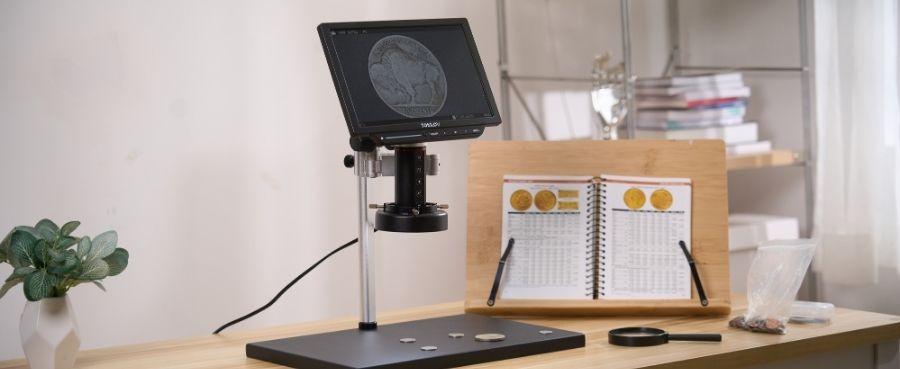
Instead of looking through a glass lens, the child points the objective lens at a specimen. An internal CMOS camera sensor captures the magnified image and instantly projects it onto a built-in LCD screen, a smartphone, or a computer monitor.
Key Features
These devices excel in ergonomics and sharing. They typically feature built-in LED ring lights for top-down illumination, internal batteries for outdoor portability, and the ability to instantly capture photos and record videos of specimens with the push of a button.
What Is a Traditional Microscope?
Traditional compound microscopes are scaled-down versions of the instruments used in professional laboratories, relying entirely on physical glass optics to magnify specimens.
How a Traditional Microscope Works
A traditional microscope uses a combination of objective lenses near the specimen and an ocular lens (eyepiece) near the observer's eye. Light from a bottom-mounted bulb shines upward, passing completely through a thin, transparent specimen mounted on a glass slide to deliver an optically pure, highly magnified image to the eye.
Key Features
The defining feature of a traditional microscope is its ability to achieve massive optical magnification (often 400x to 1000x). They feature rotating nosepieces with multiple objective lenses, a flat mechanical stage for holding prepared glass slides, and precise focal adjustment knobs.
Key Differences Between Digital and Traditional Microscopes
Comparing the functional mechanics of these two tools reveals exactly how they shape a child's learning process.
Ease of Use
Digital microscopes are incredibly intuitive for modern children raised on tablets and smartphones. Viewing a large screen requires zero optical training. Traditional microscopes require a steeper learning curve; children must learn to close one eye, adjust the interpupillary distance, and keep their head perfectly still to see the image through the eyepiece.
Learning Experience
Traditional microscopes provide a rigid, structured, authentic laboratory experience. They teach patience, slide preparation, and proper optical alignment. Digital microscopes encourage rapid, spontaneous exploration, allowing children to run around the backyard magnifying rocks, bugs, and tree bark without complex preparation.
Photo and Video Features
Documenting discoveries is seamless on a digital microscope, which saves JPGs and MP4s directly to a MicroSD card. Taking a photo through a traditional microscope requires purchasing a separate smartphone adapter mount and carefully aligning the phone's camera with the physical eyepiece.
Setup and Maintenance
Traditional microscopes require meticulous care. The glass slides are fragile, the objective lenses must be cleaned with specialized paper, and focusing requires precise knob adjustments. Digital models are largely "point-and-shoot" devices that require virtually no setup or delicate glass handling.
Durability
Because traditional microscopes utilize exposed glass lenses, mirrors, and rack-and-pinion metal gears, dropping them can cause permanent optical misalignment. Handheld digital microscopes are often encased in rugged plastic and lack external moving gears, making them significantly more resilient to the bumps and drops of active childhood play.
Which Microscope Fits Your Child Best?
Matching the instrument to your child's personality, patience level, and specific scientific interests guarantees the microscope will actually be used.
Decide What Your Child Wants to Explore
If your child wants to look at coins, feathers, whole insects, and fabric, a digital microscope with top-down lighting is required. If they are fascinated by biology and want to see onion cells, bacteria, or pond water microorganisms, they need the bottom-up transmitted light and extreme magnification of a traditional compound microscope.
Consider How Much Help They Need
Children under eight generally struggle to focus traditional microscopes independently and may become frustrated easily. A digital microscope allows a parent and child to look at the screen simultaneously, making it much easier to guide the child and point out specific details together.
Choose Screen Viewing or Eyepiece Viewing
Some children find squinting through an eyepiece physically uncomfortable or have trouble seeing a single unified image. A digital screen completely eliminates eye strain and allows multiple children to view the specimen at the same time without fighting over the eyepiece.
Check Magnification and Sample Compatibility
Traditional compound microscopes strictly require thin, transparent samples mounted on glass slides. You cannot put a whole rock under a compound microscope. Digital microscopes feature lower true magnification (usually 50x to 200x) but can view any 3D, solid object that fits under the lens.
Pick the Option They Can Use Independently
The best educational tool is the one a child can operate without constant adult supervision. If you want your child to take the microscope outside and explore independently, choose a rugged digital model. If your child is older, highly detail-oriented, and enjoys following structured scientific procedures, they will thrive with a traditional model.
Choose Digital If Your Child Wants Quick Results
For instant gratification and outdoor exploration, the TOMLOV P50K Digital Microscope for Kids is an exceptional choice. Its portable handheld design, built-in screen, and robust chassis allow kids to immediately magnify everyday objects and capture photos of their discoveries without any complex slide preparation.
Choose Traditional If Your Child Wants a Science Lab Experience
For children serious about cellular biology, the TOMLOV DM301K Microscope for Kids provides an authentic, comprehensive laboratory experience. It combines high-quality optical glass lenses for extreme magnification with dual LED lights and included prepared slides, teaching older children proper scientific methodology.
Conclusions
There is no universally "better" microscope—only the one that perfectly matches your child's age, interests, and temperament. Digital microscopes win on usability, portability, and sharing, making them perfect for younger kids and casual nature exploration. Traditional microscopes demand more patience and parental guidance but reward older children with breathtaking, high-resolution views of the hidden cellular world.
Frequently Asked Questions
Is a Digital Microscope Better for Beginners?
Yes. Digital microscopes eliminate the frustration of learning how to look through a tiny optical eyepiece. The large screen provides instant feedback, making it incredibly easy for beginners to understand how moving the device or turning the focus wheel alters the image.
Is a Traditional Microscope Better for Learning Science?
Yes, for structured biological sciences. Using a traditional microscope teaches essential laboratory skills, including how to properly create a wet mount slide, how to use stains to create cellular contrast, and how to safely navigate different high-power objective lenses.
What Magnification Does a Kid Actually Need?
For looking at bugs, leaves, coins, and fabric, 20x to 100x magnification is perfect. For looking at plant cells, blood cells, and pond water, 400x to 1000x magnification is required. Magnification claims above 1000x on kid-level microscopes are usually empty digital zoom and should be ignored.
Can Kids Use a Microscope Without Adult Help?
Children aged 8 and older can easily use a digital microscope independently after a five-minute introduction. Traditional microscopes require adult supervision for a much longer period, as children must be taught how to avoid cracking the glass slides by driving the glass objective lens down too far.
Can Kids See Cells With a Digital Microscope?
Generally, no. Standard handheld digital microscopes lack the extreme optical resolution and bottom-up transmitted lighting required to see through cell walls. To see cellular structures clearly, a traditional compound microscope is required.


发表评论
所有评论在发布前都会经过审核。
此站点受 hCaptcha 保护,并且 hCaptcha 隐私政策和服务条款适用。