

Table of Contents
What Is a Compound Microscope
A compound microscope uses two lenses, an objective lens and an eyepiece, to magnify thin samples that light can pass through. It is commonly used to view cells, bacteria, pond water, tissue slices, and other tiny details that are invisible to the naked eye.
Unlike a stereo microscope, it is not made for solid objects like coins or insects. Its real strength is helping students, hobbyists, and lab users see the structure inside small, transparent specimens.
How a Compound Microscope Actually Works
Most explanations overcomplicate this part, and it doesn't need to be hard.
The Two-Lens Magnification Trick
Light passes through the thin specimen on the glass slide. The objective lens, just above it, catches that light and creates a magnified image inside the body tube. The eyepiece magnifies that image a second time and projects it into your eye. The math is simple: multiply the objective's magnification by the eyepiece's. A 40x objective with a 10x eyepiece gives you 400x total. Every magnification number on every microscope box comes from this multiplication, and once you see it that way, inflated numbers on cheap products look a lot less impressive.
Why Light Behind the Sample Matters
Compound microscopes are transmitted-light instruments — the light passes through the specimen rather than bouncing off its surface. That's why they're brilliant for thin, semi-transparent samples and almost useless for solid objects like a coin or a beetle wing. It's also why specimens have to be sliced thin or smeared in a single layer to be worth looking at. Hold this idea — it's the single biggest distinction between compound microscopes and the other types you'll see for sale.

The Anatomy of a Compound Microscope
Knowing what each part does makes setup and troubleshooting ten times easier.
The Optical Parts Where the Magic Happens
At the top sits the eyepiece, usually 10x. Binocular scopes have two eyepieces and are far more comfortable for long sessions. Below that, on a rotating nosepiece, sit the objective lenses — a standard set runs 4x, 10x, 40x, and 100x. The 100x is an oil immersion objective, requiring a drop of special oil between lens and slide. Beneath the stage you'll find the condenser, which focuses light onto your specimen. Budget scopes use fixed condensers; better models have adjustable Abbe condensers that dramatically improve clarity at higher magnifications.
The Mechanical Parts Where Frustration Often Hides
The stage holds your slide. A mechanical stage — with two knobs that nudge the slide along its X and Y axes — is one of those upgrades you can't unfeel once you've used one; hunting for a cell at 400x without one feels like steering a car with six inches of slack. Two focus knobs do very different jobs: the coarse knob makes large movements at low magnification, and the fine knob handles precise adjustments above 10x, where the depth of field is so shallow that one rough turn can crack a slide. Always carry the microscope by the arm, never the stage.
The Illumination System
Modern compound microscopes use LED illumination — cool, long-lasting, battery-friendly. Beneath the stage sits an iris diaphragm, an aperture that controls how much light reaches the slide. It's easy to overlook, but it's the single biggest contrast control on the entire microscope. Transparent specimens look like faint ghosts under full light; close the diaphragm partway and they snap into clear definition.
Compound vs. Other Microscopes
This is where most people get tripped up before buying.
Compound vs. Stereo Microscope
A stereo microscope uses two separate optical paths to give a three-dimensional view of solid objects at low magnification, typically 10x to 40x — the right tool for coins, insects, circuit boards, and gems. A compound microscope is built for flat, thin, transparent samples at higher magnifications, 40x to 1000x — cells, bacteria, blood smears, pollen. Quick test: if you can already see the object with your naked eye and want a closer look at its surface, you want a stereo. If it's invisible or paper-thin and you want to see inside its structure, you want a compound.
Compound vs. Digital Microscope
A digital microscope replaces or supplements the eyepiece with a built-in camera that streams to a screen. Many compound microscopes now ship with a camera or USB port, so it isn't really compound-or-digital anymore. Digital is excellent for group viewing, classroom demos, and capturing images. Optical eyepieces still win on raw resolution at the highest magnifications, so most serious users end up wanting both.
Related Reading: What Is A Digital Microscope And How Does It Work?
When Each One Is the Right Tool
Ask what you actually want to look at and let that answer decide. Microorganisms or anything cellular → compound. Insects, coins, gems, soldering work, anything you can pick up and turn between your fingers → stereo. Sharing what you see with a class or saving images → compound with a digital camera or trinocular port.
What You Can Actually See Through a Compound Microscope
The magnification number on the box rarely tells you what you'll really see.
Specimens That Look Stunning Under a Compound Microscope
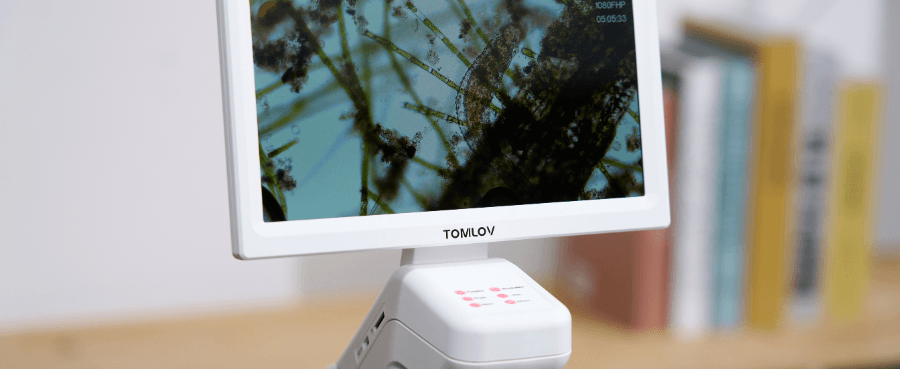
Some specimens have become classics for good reason. Onion skin shows clear, geometric cell walls and visible nuclei, which is why every biology teacher reaches for it on day one. Your own cheek cells, scraped with a toothpick and stained with methylene blue, are beautifully defined at 400x. Pond water is the surprise hit of the entire category — even a few drops from a backyard puddle reveal paramecia darting around, slow-motion rotifers, algae filaments, and occasionally amoebas oozing across the slide. Blood smears, pollen grains, and (with oil immersion) bacteria all open up at 400x and beyond.
What a Compound Microscope Cannot Show You
A compound microscope can't help with solid, opaque objects, because no light passes through them. It also won't reveal living things you haven't prepared on a thin slide. And it absolutely won't deliver useful detail at the 1500x or 2000x magnifications plastered across budget product listings. Beyond roughly 1000x, additional magnification stops adding information and just blows up the same blur larger. This is called empty magnification, and it's the single biggest spec lie in budget microscope marketing — a clean 400x view almost always beats a fuzzy 2000x one.

How to Choose a Compound Microscope You Won't Regret
The decision gets much easier once you know which user you're buying for and which specs actually matter.
Match the Microscope to the User
For kids six to ten, durability matters more than magnification. Look for a sturdy metal frame, LED light, and a range topping out around 400x — and avoid the plastic toys advertised at 1200x, which exist mainly to disappoint motivated kids. Middle school through high school students and adult hobbyists sit in the sweet spot: a monocular or binocular scope with 4x, 10x, and 40x objectives, mechanical stage, and LED illumination handles most biology curricula and curious adult projects. Serious hobbyists benefit from a binocular head, Abbe condenser, 100x oil immersion objective, and a trinocular port for adding a camera later.
Reading the Magnification Number Like a Pro
When a listing screams "2000x magnification," ignore the headline and look elsewhere for the real story. What matters is the specific objective lenses included — a genuine lineup looks like 4x, 10x, 40x, and 100x. If a listing avoids specifying objectives and only quotes a max, that vagueness is itself the answer. Some manufacturers hit big numbers by pairing an aggressive 20x eyepiece with a 100x objective, which is mathematically correct but optically just enlarges blur unless the glass is exceptional. The only honest path to a crisp 1000x view runs through a real oil immersion 100x objective used with proper immersion oil.
Features Worth Paying For and Features to Skip
Genuine upgrades worth their cost: a mechanical stage, a binocular head, LED with brightness control, an Abbe condenser with iris diaphragm (probably the single biggest contrast upgrade at a reasonable price), and achromatic or plan-achromatic objectives. Skip extreme magnification claims above 1000x without oil immersion, gimmicky built-in projectors on kid models, and the phone-clip "digital adapters" that ship as freebies — they're flimsy and usually end up in a drawer.
How To Get A Clear First View Through A Microscope
Most beginner frustration comes down to skipping a few basics.
A Repeatable First-View Routine
Place the slide on the stage with the specimen centered over the light hole, and clip it down. Always start with the 4x objective rotated into position — jumping straight to 400x and trying to find your specimen blind is one of the most common beginner mistakes. Turn on the light, open the iris diaphragm fully, look through the eyepiece, and slowly turn the coarse focus knob until the image resolves. Once you've found your specimen at 4x, rotate to 10x and use the fine focus knob alone to sharpen, then repeat for 40x. For 100x, add a drop of immersion oil on the slide first — and never use oil with the 40x objective, because contact can damage lenses that aren't rated for it.
Beginner Mistakes That Quietly Ruin the Experience
Most disappointment traces back to the same habits. Jumping straight to high magnification leaves you hunting blindly. Touching the objective lens leaves skin oils that degrade the coating, so always hold the nosepiece, never the lens. Cranking the coarse focus knob above 10x can ram the objective into the slide and crack both. Ignoring the condenser and diaphragm produces washed-out images of perfectly good specimens. And cleaning lenses with tissue paper scratches the coatings — a smudged eyepiece, more often than people realize, is the real culprit when a microscope seems to have stopped working.
Final Thoughts
A compound microscope is the right tool for one specific kind of curiosity: the desire to see inside the structure of small, thin, transparent things. Once you understand the two-lens system, recognize empty magnification, and match the scope to the actual user, the buying decision becomes much less intimidating. Set it up on a stable desk, drop a slide of pond water on the stage, start at 4x, and work your way up. You'll be hooked before the first hour is over.


Commenta
Nota che i commenti devono essere approvati prima di essere pubblicati.
Questo sito è protetto da hCaptcha e applica le Norme sulla privacy e i Termini di servizio di hCaptcha.