
Table of Contents
Choosing the right digital microscope depends on your daily workflow. Manual focus models offer precise, affordable control that is perfect for inspecting stationary objects. In contrast, autofocus systems provide hands-free speed for dynamic, repetitive tasks. This guide compares both to help you decide.
How Manual Focus Works
Manual focus relies entirely on your physical input and your personal judgment of image clarity. The microscope features a physical dial or a textured ring connected directly to the internal lens array. As you slowly twist this dial with your fingers, you physically move the camera sensor either closer to or farther away from the specimen. You must carefully watch the digital monitor and stop turning the dial the exact moment the image appears sharpest to your eyes.
How Autofocus Works
Autofocus technology removes human physical input from the clarity equation entirely. These advanced microscopes use integrated software algorithms and tiny motorized lenses to analyze the live video feed continuously. The internal computer measures the contrast of the pixels on the screen and automatically drives the lens motor back and forth until it detects the highest possible contrast, which indicates a perfectly sharp edge. This entire mechanical and digital process happens in a fraction of a second without you ever having to touch the equipment.

Manual Focus Digital Microscope Benefits
Traditional physical control remains incredibly popular across multiple industries for several very good reasons.
Provides Precise Focus Control
The greatest advantage of a physical dial is absolute authority over the image. When you look at a complex three-dimensional object, you might want to inspect a specific layer resting deep inside a cavity. A manual dial allows you to bypass the top surface entirely and lock your view exactly where you want it. The camera will never try to aggressively correct your intended view.
Works Well for Stable Objects
If your daily workflow involves looking at perfectly flat items, automated features are largely unnecessary. Collectors inspecting postage stamps, biologists looking at prepared glass slides, and jewelers evaluating loose diamonds on a stationary stage will find physical dials perfectly adequate. Once you set the dial for a flat object, the image remains perfectly crisp for the entire viewing session.
Offers a More Affordable Option
Because they lack complex internal motors and advanced contrast detection software, traditional digital models are significantly cheaper to manufacture. This simplicity directly translates to a much lower retail price. For beginners, students, or hobbyists on a strict budget, opting for physical controls allows you to acquire a high quality optical lens and a great screen without spending money on automated luxuries.
Autofocus Digital Microscope Benefits
Automated lens technology brings a massive level of convenience and speed to demanding professional environments.
Saves Time During Repeated Inspections
When you must inspect fifty identical circuit boards in a single hour, touching a dial fifty separate times becomes incredibly tedious. Automated systems lock onto the new object the very second you slide it under the camera lens. This instantaneous adjustment eliminates constant fiddling and drastically reduces the total time required to process large batches of materials.
Helps When Working Distance Changes
Certain tasks require you to physically raise or lower the entire camera housing to get a wider view of your workspace. With a traditional setup, changing the stand height immediately blurs the screen, forcing you to recalibrate the dial. Automated systems instantly recognize the change in height and recalibrate the optics on the fly, maintaining a crystal-clear image while you adjust your equipment.
Keeps Your Hands Free During Tasks
Micro soldering, watch repair, and complex assembly tasks require the constant use of both of your hands. If the image becomes slightly blurry because you accidentally bumped the circuit board, having to put down your soldering iron to twist a dial is highly disruptive. An automated camera corrects the blur independently, allowing you to keep your tools in your hands and your eyes focused entirely on the work.
Key Differences Between Manual Focus and Autofocus
Comparing these two technologies side by side reveals distinct differences in how they affect your daily operational efficiency.
Focus Speed and Convenience
Automated systems are unquestionably faster for the average user. The software can calculate the optimal focal distance and drive the internal motor in milliseconds. Conversely, physically turning a wheel requires you to overshoot the focal point slightly and then slowly dial it back until your eyes confirm the clarity, a process that inherently takes several seconds of trial and error every single time.
Focus Accuracy and Control
While automated systems are fast, they are not always smart. If you place a circuit board under an automated lens, the camera might focus on a tall capacitor when you actually wanted to look at the flat trace directly beneath it. Physical dials provide absolute targeting accuracy because you tell the lens exactly which specific vertical plane to highlight, entirely ignoring the surrounding distractions.
Ease of Use for Beginners
An automated camera is a true plug-and-play device. A beginner can turn the machine on, place a leaf on the stage, and instantly see a perfect picture. Operating a physical dial requires a slight learning curve. Beginners often turn the wheel too aggressively, completely missing the narrow focal window and becoming frustrated when the screen remains blurry.
When Manual Focus Is the Better Choice
Selecting a physical dial makes the most sense when predictability and extreme precision are your primary goals.
You Inspect Mostly Fixed Samples
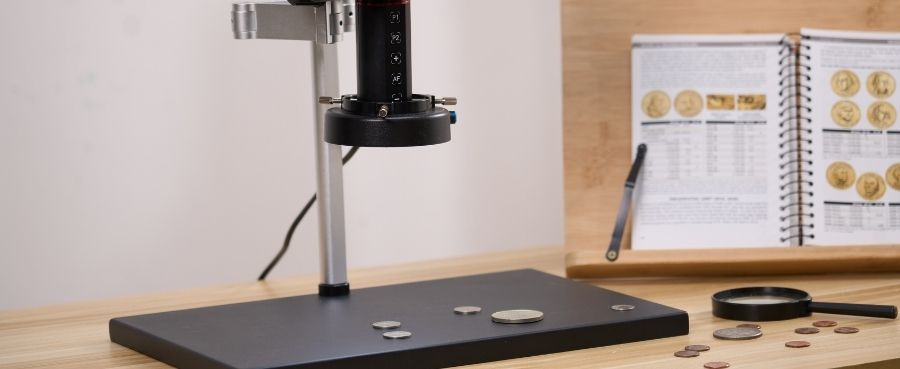
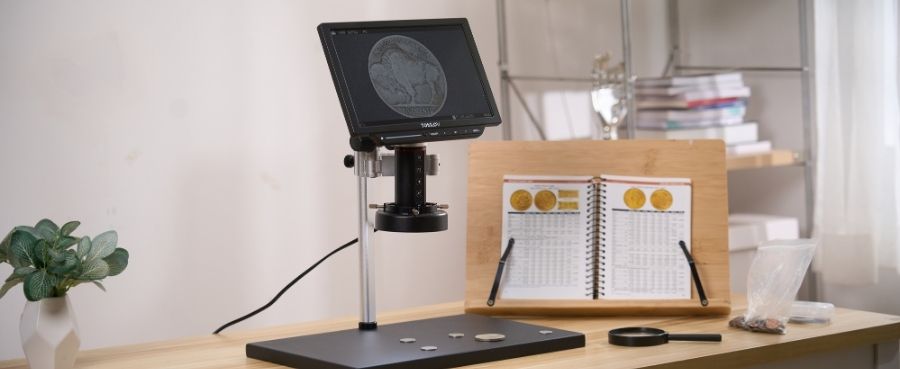
If your workspace involves looking at stationary objects that do not vary wildly in height, manual control is absolutely the right choice. Grading coins, inspecting flat fabric swatches, or reading serial numbers on flat metal plates requires you to set the optical clarity exactly one time for the entire day.
You Need Complete Focus Control
Inspecting the interior walls of a drilled hole or looking through a scratched piece of transparent plastic requires you to actively fight the camera. Automated systems will constantly try to focus on the top edge of the hole or the scratch on the plastic. Physical control allows you to push past these foreground obstacles and force the camera to look deeper into the subject.
You Want a Simple Setup
More moving parts generally mean more opportunities for mechanical failure. If you work in a dusty workshop or an industrial environment where equipment takes a lot of abuse, a simple mechanical wheel is incredibly reliable. There are no software algorithms to glitch and no tiny internal motors to burn out over years of heavy daily use.
When Autofocus Is the Better Choice
Upgrading to an automated system is highly recommended when your environment is fast-paced and highly dynamic.
You Frequently Move Objects
If you are constantly picking up an object, rotating it to check different angles, and placing it back down, your distance from the lens changes every few seconds. An automated camera will track these constant spatial changes flawlessly, keeping the object sharp no matter how many times you manipulate it under the light.
You Perform Repetitive Inspections
Quality control stations in manufacturing plants rely heavily on speed and consistency. When an operator must slide hundreds of parts under a lens during a single shift, eliminating the need to reach for a dial prevents severe operator fatigue. The automated camera handles the visual heavy lifting so the operator can focus entirely on identifying product defects.
You Need Faster Workflow

When your income depends entirely on how quickly you can complete a repair, stopping your progress to tweak an optical dial ruins your momentum. Modern inspection tasks require fluid movement and uninterrupted concentration. Advanced equipment demonstrates exactly how valuable this specific technology has become for active workbenches. For example, a system like Tomlov Autofocus 4K Digital Microscope 8" TM4K-AF Flex Arm HDMI Micro Soldering Microscope utilizes a rapid automated sensor to lock onto the subject instantly, even when mounted on a flexible arm that naturally sways during positioning. This capability ensures your view remains perfectly sharp without intervention, validating the idea that smart automation directly improves your professional workflow speed.
Final Thoughts
The decision between automated and physical optical control ultimately comes down to understanding your primary daily tasks. Manual dials offer unmatched precision, total authority over the viewing plane, and rugged reliability for stable objects. Automated cameras deliver incredible speed, hands-free operation, and massive convenience for dynamic workflows and repetitive tasks. By carefully evaluating how often you move your hands and how much control you truly need over the viewing depth, you can confidently select the perfect digital microscope to elevate your professional or hobbyist workspace.
Frequently Asked Questions
What are common problems with digital microscopes?
Users frequently encounter issues with harsh glare reflecting off shiny surfaces and washing out the image. Input lag is another common complaint with cheaper models, where moving an object by hand takes a fraction of a second to register on the screen. Finally, poor lighting can cause the digital sensor to produce grainy or highly pixelated video feeds.
Can you see bacteria with a digital microscope?
In almost all cases, you cannot see bacteria with standard digital inspection equipment. Viewing bacteria requires a specialized biological compound microscope capable of one thousand times optical magnification, combined with oil immersion lenses and light transmitted directly through a glass slide. Standard digital models are designed for solid surface inspection at much lower magnifications.
Can Autofocus Be Turned Off on a Digital Microscope?
Yes, almost all high-quality automated digital microscopes feature a manual override option. You can usually press a button on the remote control or tap an icon on the digital screen to disable the automated motor. This fantastic feature allows you to enjoy the speed of automation most of the time while still retaining the ability to lock the optics manually when dealing with tricky subjects.


发表评论
所有评论在发布前都会经过审核。
此站点受 hCaptcha 保护,并且 hCaptcha 隐私政策和服务条款适用。