

Table of Contents
Many parents wonder whether a microscope truly helps kids learn science or simply looks educational. This guide explains how microscopes support real learning, when they work best, and how to decide if one is right for your child.
HOW A MICROSCOPE SUPPORTS SCIENCE LEARNING FOR KIDS
At its core, science is about observing the world, asking questions, and testing ideas. A microscope supports this process by making small details visible and meaningful.
Turning Abstract Concepts Into Something Kids Can See
Many science topics taught in school involve things children cannot directly observe. Cells, textures, and tiny structures are often described using diagrams or videos. While helpful, these methods can feel distant and hard to connect with.
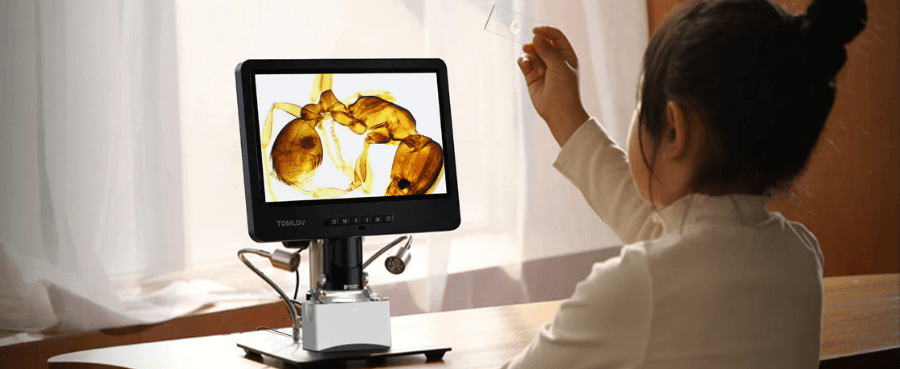
A microscope changes that experience. When kids look at a leaf and realize it is made up of visible structures, or examine fabric fibers and see how they are woven, science becomes real. The learning shifts from “someone told me this exists” to “I can actually see it myself.” That shift is powerful because it builds understanding through direct experience, not memorization.

WHY A MICROSCOPE FOR KIDS CAN INCREASE CURIOSITY AND MOTIVATION
Curiosity is one of the strongest drivers of learning, especially for children. A microscope often works well because it invites exploration rather than forcing instruction.
Encouraging Self-Directed Exploration At Home
Unlike many educational tools that follow strict instructions, a microscope gives kids freedom. They decide what to look at. One day it might be a flower petal, the next day a grain of salt or a strand of hair.
This freedom leads to natural questions. Why does this look different? Why are some samples clearer than others? Why does changing focus matter? These questions are not assigned by a teacher; they come from the child’s own observations. When learning starts this way, motivation tends to last longer because the child feels in control of the process.
SKILLS KIDS DEVELOP WHEN USING A MICROSCOPE FOR KIDS
The benefits of a microscope are not limited to science knowledge. The process of using one builds several important skills.
Observation, Patience, And Analytical Thinking
Using a microscope is not instant. Kids need to adjust focus, lighting, and positioning. At first, images may look blurry or confusing. With practice, children learn to slow down, make small adjustments, and pay attention to detail.
Over time, this builds:
-
Strong observation skills
-
Patience and persistence
-
The ability to compare and describe differences
These are foundational skills that support learning in science, math, and even language development.
HOW A MICROSCOPE CONNECTS TO SCHOOL LEARNING
Parents often wonder whether a microscope actually helps with schoolwork or if it is just extra activity at home.
Reinforcing Classroom Topics Through Real Examples
When kids study plants, insects, or basic biology at school, a microscope allows them to revisit those topics at home in a hands-on way. Instead of just reading about cells or structures, they can see related examples themselves.
This reinforcement helps children:
-
Remember concepts more clearly
-
Build confidence in science subjects
-
Feel more engaged during class discussions
The microscope becomes a bridge between abstract lessons and real-world understanding.
WHEN A MICROSCOPE MAY NOT BE THE RIGHT TOOL
Despite its benefits, a microscope is not a perfect fit for every child or household.
Common Challenges Parents Encounter
Some kids lose interest quickly, not because the microscope lacks value, but because expectations do not match reality. Common issues include:
-
The microscope being too complex for the child’s age
-
Lack of guidance or activity ideas
-
Frustration with focusing or setup
In these cases, the microscope feels like work rather than discovery. Recognizing these challenges early helps prevent disappointment.

HOW TO MAKE A MICROSCOPE MORE EFFECTIVE FOR LEARNING
The way a microscope is introduced often matters more than the microscope itself.
Practical Ways To Support Long-Term Engagement
Parents do not need to become science experts, but small actions can make a big difference:
-
Start with everyday objects your child already knows
-
Ask simple questions about what they notice
-
Encourage drawing or writing short notes about observations
-
Connect what they see to real-life examples
These steps help kids reflect on what they observe and turn viewing into learning.
CHOOSING THE RIGHT MICROSCOPE FOR KIDS BASED ON AGE AND INTEREST
Not all microscopes for kids are designed the same. Choosing the right level for your child ensures they stay engaged and learn effectively.
Matching Complexity To Your Child’s Readiness
General age-based considerations:
-
Younger kids benefit from sturdy, simple microscopes with fewer controls
-
Elementary-age kids can handle basic focusing and prepared slides
-
Older kids may enjoy higher magnification and experiment-based setups
A microscope that is too advanced can discourage learning, while one that is too simple may not hold attention.
Related Reading: What to look for when buying a microscope for kids?
FREQUENTLY ASKED QUESTIONS
Does a microscope really help kids understand science better?
Yes, especially when it encourages observation and questioning rather than passive learning.
What age is best to introduce a microscope for kids?
Many children benefit in elementary school, but readiness matters more than age alone.
Will my child get bored quickly?
Interest lasts longer when kids explore familiar objects and receive simple guidance.
Is a microscope better than other science toys?
It depends on the child’s interests. Microscopes are best for kids who enjoy discovery.
Do parents need science knowledge to help?
No. Curiosity, questions, and encouragement are more important than technical explanations.
FINAL THOUGHTS
A microscope is not just about magnification. It is about helping kids see the world differently. For children who enjoy exploring, asking questions, and learning through hands-on experiences, a microscope can be a meaningful way to support science learning at home. When chosen carefully and used with intention, it can turn everyday objects into powerful learning moments that spark long-term curiosity.

Laisser un commentaire
Tous les commentaires sont modérés avant d'être publiés.
Ce site est protégé par hCaptcha, et la Politique de confidentialité et les Conditions de service de hCaptcha s’appliquent.