
Table of Contents
Choosing a microscope for electronics repair can be confusing. USB microscopes and digital soldering microscopes look similar online, but they perform very differently at the repair bench. This guide compares how each one actually works in real soldering tasks, so you can choose the option that fits your projects and work style.
WHY THE RIGHT MICROSCOPE MAKES REPAIR WORK FEEL EASIER
Electronics repair is not just about seeing small details. It is about how comfortably and confidently you can work while seeing them.
Better Visibility Reduces Mental Strain
When the image is clear, stable, and properly lit, you stop second-guessing your work. You can:
-
See solder flow as it happens
-
Judge joint quality instantly
-
Avoid rework caused by missed bridges or cold joints
This clarity directly translates into calmer, more satisfying repair sessions.
A Comfortable Setup Keeps You in the Flow
When your microscope setup works with you instead of against you, you spend less time adjusting and more time repairing. That sense of flow is what makes long sessions feel productive rather than exhausting.

DIGITAL SOLDERING MICROSCOPE IN REAL SOLDERING TASKS
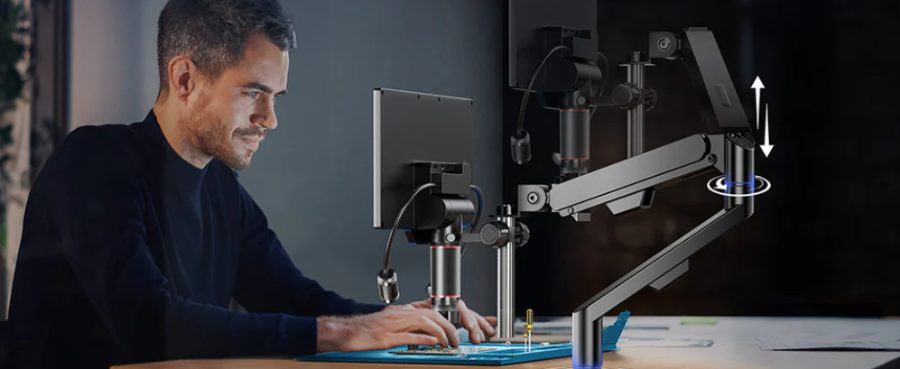
A digital soldering microscope is designed around one goal: making active soldering feel natural under magnification.
Designed for Hands-On Soldering
These microscopes provide a longer working distance, which means:
-
Your soldering iron, tweezers, and hot air tools fit comfortably
-
Your hands are not cramped or blocked by the lens
-
You can work steadily without fear of bumping the camera
This physical comfort is one of the biggest quality-of-life improvements for repair work.
Stable Image Builds Confidence
A rigid stand and well-balanced arm keep the image steady even when you move your hands. This stability helps you:
-
Align fine-pitch components accurately
-
Control solder precisely
-
Trust what you see on the screen
When the image stays where you expect it to, your confidence naturally increases.
Less Adjustment, More Progress
With fewer focus and positioning adjustments, your workflow becomes smoother. You stay focused on the repair itself, which makes each task feel more efficient and rewarding.
USB MICROSCOPE FOR ELECTRONICS REPAIR
USB microscopes can still bring value, especially when used in the right context.
Useful for Inspection and Verification
USB microscopes work well for:
-
Checking solder joints after reflow
-
Inspecting traces, pads, and component markings
-
Capturing images for documentation
For these tasks, they offer a simple and affordable way to see fine details clearly.
Limitations During Live Soldering
During active soldering, comfort becomes an issue:
-
Short working distance leaves little room for tools
-
Small movements can shift the image
-
Frequent repositioning breaks concentration
These interruptions can turn otherwise simple repairs into frustrating experiences.
DIGITAL SOLDERING MICROSCOPE VS. USB MICROSCOPE AT THE BENCH
|
Daily Use Experience |
Digital Soldering Microscope |
USB Microscope |
|
Tool Clearance |
Plenty of space for hands and tools |
Limited at higher magnification |
|
Image Stability |
Rigid and predictable |
Highly dependent on stand |
|
Soldering Comfort |
Designed for live rework |
Better for inspection only |
|
Workflow Flow |
Smooth and uninterrupted |
Frequent pauses and adjustments |
Related Reading: How To Choose Your First Digital Microscope

WHICH OPTION FITS YOUR WORK STYLE BEST
Best Choice for Frequent Repair and Rework
If you regularly solder SMD components or perform detailed rework, a digital soldering microscope offers:
-
Less fatigue
-
Fewer mistakes
-
A more enjoyable repair experience
Over time, this comfort adds up and makes your bench work something you actually look forward to.
Best Choice for Light Repair and Inspection
If your work is mostly inspection or occasional soldering, a USB microscope can still be a satisfying choice. It keeps things simple and accessible without a large upfront investment.
WHAT ACTUALLY IMPROVES YOUR REPAIR EXPERIENCE
Usable Magnification Beats Extreme Zoom
Moderate magnification with good clarity and working distance feels far better than extreme zoom that restricts movement.
Stability and Lighting Matter More Than Specs
A stable stand and adjustable lighting reduce eye strain and reveal solder quality more clearly than higher resolution alone.
FINAL THOUGHTS
The real difference between a digital soldering microscope and a USB microscope is how they make you feel while you work. One supports your hands, eyes, and focus during soldering. The other is better suited for checking results after the work is done.
Choosing the right microscope is about removing friction from your repair process. When your tools work with you, electronics repair becomes smoother, more confident, and genuinely more satisfying.


Hinterlasse einen Kommentar
Alle Kommentare werden vor der Veröffentlichung geprüft.
Diese Website ist durch hCaptcha geschützt und es gelten die allgemeinen Geschäftsbedingungen und Datenschutzbestimmungen von hCaptcha.