
Table of Contents
Every compound microscope has two sets of lenses doing the work — the objective lens sits just above the specimen and creates the initial magnified image, while the ocular lens (the eyepiece) sits at the top and magnifies that image again for your eye. The objective does the heavy lifting on resolution and detail; the ocular finishes the job so you can actually see it. Get either one wrong, and the image suffers.
What is an objective lens?
The objective lens is the lens closest to the specimen — the one mounted on the rotating nosepiece just above the stage. It's the optical component that gathers light from the sample and forms the first real, magnified image inside the microscope tube.
Most compound microscopes carry three or four objectives at different powers: typically 4x, 10x, 40x, and 100x. Each one is engineered to a specific magnification and numerical aperture (NA), and the NA is what actually determines how much fine detail the lens can resolve. A 40x objective with a high NA will outperform a 40x objective with a lower NA every time, even though the magnification number is identical.
What Is an Eyepiece (Ocular Lens)?
The ocular lens, or eyepiece, is the lens you look into at the top of the microscope. Its job is to take the intermediate image produced by the objective and magnify it a second time so the final image is large enough for your eye — or a camera sensor — to capture comfortably.
Most eyepieces are 10x, though 5x, 15x, and 20x options exist for specific applications. The eyepiece also defines the field of view — how much of the specimen you see at once — and its eye relief determines how close you need to put your eye to the lens. For long observation sessions, a high-eye-relief ocular makes a real difference in comfort. If you're using one of the digital microscope setups, the ocular is replaced by a screen, but the optical principle stays the same.

Objective lens vs ocular lens: the key differences
Position on the microscope
The objective sits on the nosepiece directly above the stage and specimen. The ocular sits at the top of the body tube, where your eye meets the instrument. Light travels through them in that order — specimen → objective → tube → ocular → eye.
Function in the optical path
The objective forms the primary magnified image. The ocular acts like a magnifying glass on that image, enlarging it further without adding new optical information. This is why the objective is the more critical of the two for image quality.
Magnification range
Objectives typically range from 4x to 100x. Oculars usually sit at 10x, sometimes 15x or 20x. Objectives offer far more variety because they do the bulk of the work.
Impact on resolution and image quality
Resolution — the ability to distinguish two fine points as separate — comes almost entirely from the objective's numerical aperture. The ocular cannot improve resolution; it can only enlarge what the objective has already resolved. Push the ocular magnification too high without matching objective NA, and you get "empty magnification" — a bigger image with no extra detail.
|
Feature |
Objective Lens |
Ocular Lens |
|
Position |
Above the specimen |
At the top, near the eye |
|
Typical magnification |
4x, 10x, 40x, 100x |
10x (usually) |
|
Forms which image |
Primary real image |
Final virtual image |
|
Determines resolution |
Yes (via NA) |
No |
|
User adjusts during use |
Yes (rotates nosepiece) |
Rarely changed |
How the two lenses work together
The objective forms the real image
When light passes through the specimen, the objective collects it and bends it to form a magnified real image inside the body tube. "Real" here means the image actually exists in space and could be projected onto a screen. This is where detail and resolution are locked in.
The ocular magnifies it for your eye
The ocular then treats that intermediate image as its own specimen, magnifying it again to produce the virtual image your eye perceives. It's a two-stage relay: objective creates, ocular delivers.
How to calculate total magnification
The formula: objective × ocular
Total magnification equals objective magnification multiplied by ocular magnification. It's that simple.
A worked example: If your microscope has a 40x objective and a 10x ocular, total magnification is 40 × 10 = 400x. Swap to the 100x oil-immersion objective with the same 10x ocular, and you're at 1,000x. Put a 15x eyepiece on the 40x objective instead, and you reach 600x — though whether that extra magnification gives you more detail depends entirely on the objective's NA.
For sharper focus across that whole range, an auto focus microscope handles the fine adjustments automatically as you switch between objectives, which is genuinely useful when you're working at higher powers and even tiny focus drift becomes obvious.
How do you pick the right lens for your microscope?
What to look for in an objective lens
Start with what you're actually viewing. Bacteria and blood cells need a 100x oil-immersion objective with high NA. Plant tissue and onion cells are well-served by 10x and 40x. Insects and larger specimens often need only a 4x for scanning.
Check the numerical aperture — it's printed on the side of every objective. A higher NA means better resolution and more light-gathering ability. Working distance matters too: longer working distances give you more room to maneuver between lens and specimen, which is valuable for thick samples or live work.
What to look for in an ocular lens
Most users do fine with a standard 10x eyepiece. Step up to 15x or 20x only if your objectives have the NA to support that extra magnification — otherwise you're enlarging blur. Look for wide-field oculars if you want a larger field of view, and prioritize high eye relief if you wear glasses or expect long sessions at the eyepiece.
Also confirm tube diameter compatibility. Most eyepieces are 23.2 mm or 30 mm — they're not interchangeable across all microscope brands.

What do most people get wrong when choosing microscope lenses?
Treating magnification as the main metric
The most common mistake. A 2000x microscope with a low-NA objective shows less real detail than a 400x microscope with a high-NA one. Magnification without resolution is just bigger blur.
Skipping the compatibility check
Objectives and eyepieces are not universal. Tube length, thread type, and optical correction all need to match the microscope. A premium objective from one system mounted on the wrong body produces worse images than a basic matched objective.
Underestimating optical quality
Glass quality, coatings, and aberration correction matter more than spec-sheet numbers suggest. Achromatic, semi-plan, and plan objectives each handle color and field flatness differently — plan objectives keep the entire field in focus, which is worth the extra cost for photography. A well-built unit like the Tomlov digital microscope pairs the optical path with the sensor it was designed for, which saves a lot of guesswork compared to mixing and matching components.
Ignoring viewing comfort
Eye strain after twenty minutes at the eyepiece is almost always an eye-relief problem. Test the ocular if you can, especially if you wear glasses. For digital workflows, screen size and refresh rate matter for the same reason — comfort during long sessions is not a luxury, it's how you avoid mistakes.
Conclusion
Objective and ocular lenses do different jobs in the same optical chain — one forms the image, the other delivers it. The objective is where resolution and detail come from; the ocular is where you read the final result. Match them to your specimen, check the numerical aperture before chasing magnification numbers, and confirm compatibility before swapping anything. Get those three right and the microscope will show you what it's actually capable of.
FAQs
What is objective lens in microscope?
The objective lens is the lens mounted closest to the specimen on a microscope's rotating nosepiece. It forms the primary magnified image and sets the resolution limit through its numerical aperture. Most compound microscopes have three to four objectives at different magnifications.
What is the shortest objective called?
The shortest physical objective is typically the scanning objective, usually 4x. It has the shortest barrel, the lowest magnification, and the longest working distance, making it the right starting point for locating a specimen before moving to higher powers.
Why is the ocular lens usually 10x?
10x is a practical compromise: enough magnification to make the objective's image comfortably visible without adding so much that "empty magnification" sets in. It also pairs cleanly with standard objective magnifications to produce familiar total-magnification values (40x, 100x, 400x, 1000x).
Can you use a microscope without an eyepiece?
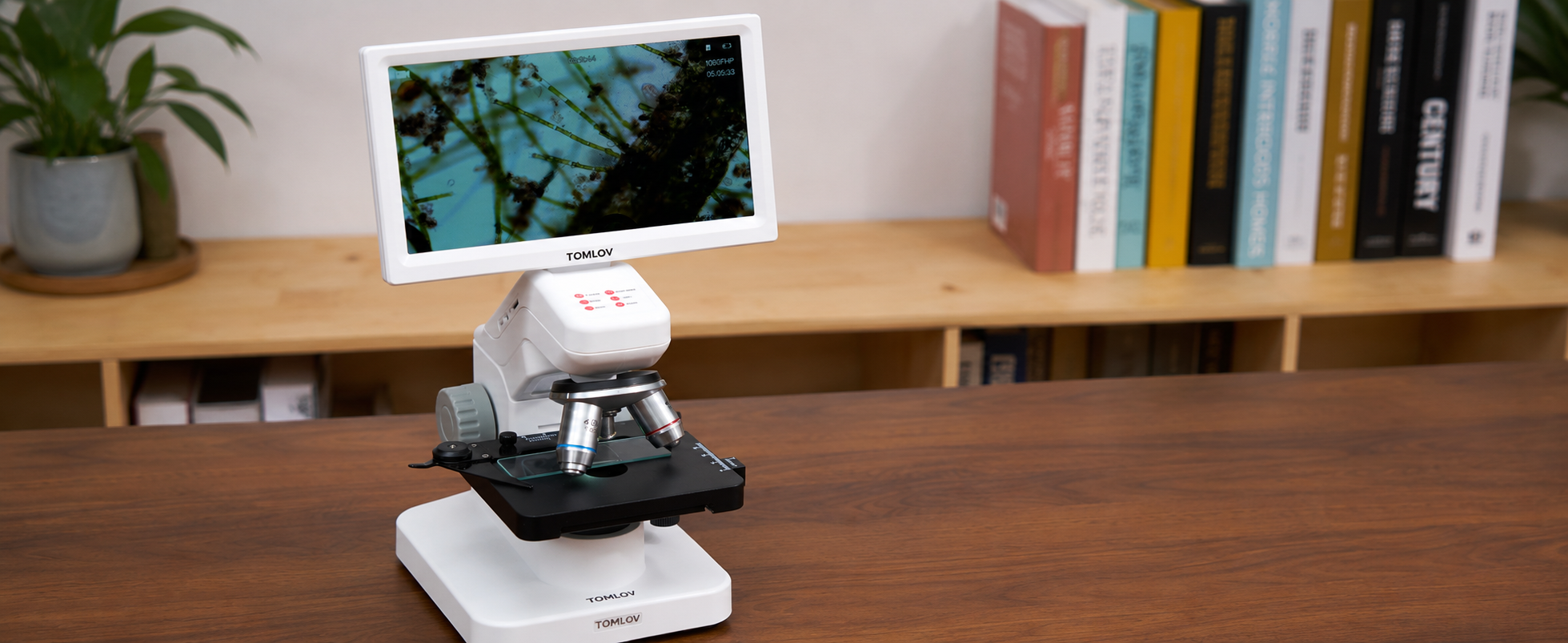
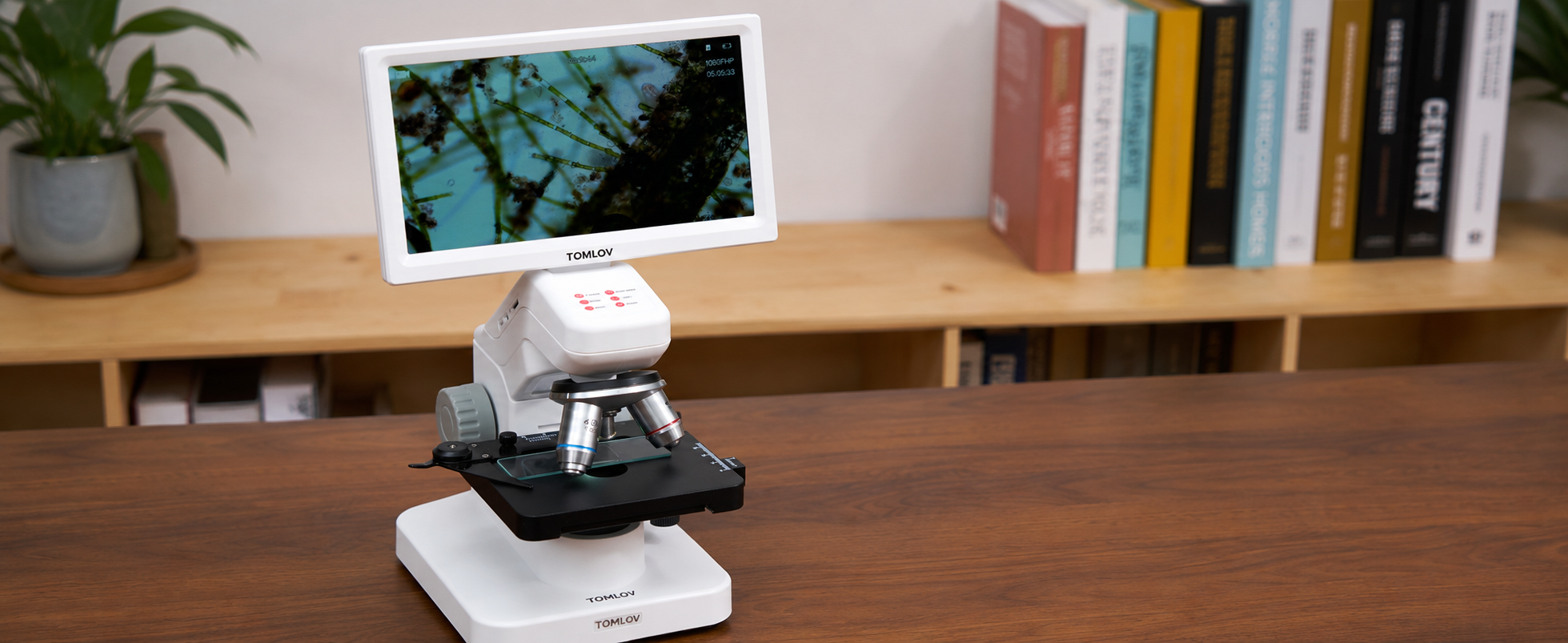
Yes — digital microscopes replace the eyepiece with a camera sensor that sends the image to a screen. The objective still does the same work; only the final viewing stage changes. This is what makes digital systems useful for groups, photography, and any application where multiple people need to see the same image at once.

Leave a comment
All comments are moderated before being published.
This site is protected by hCaptcha and the hCaptcha Privacy Policy and Terms of Service apply.