
Table of Contents
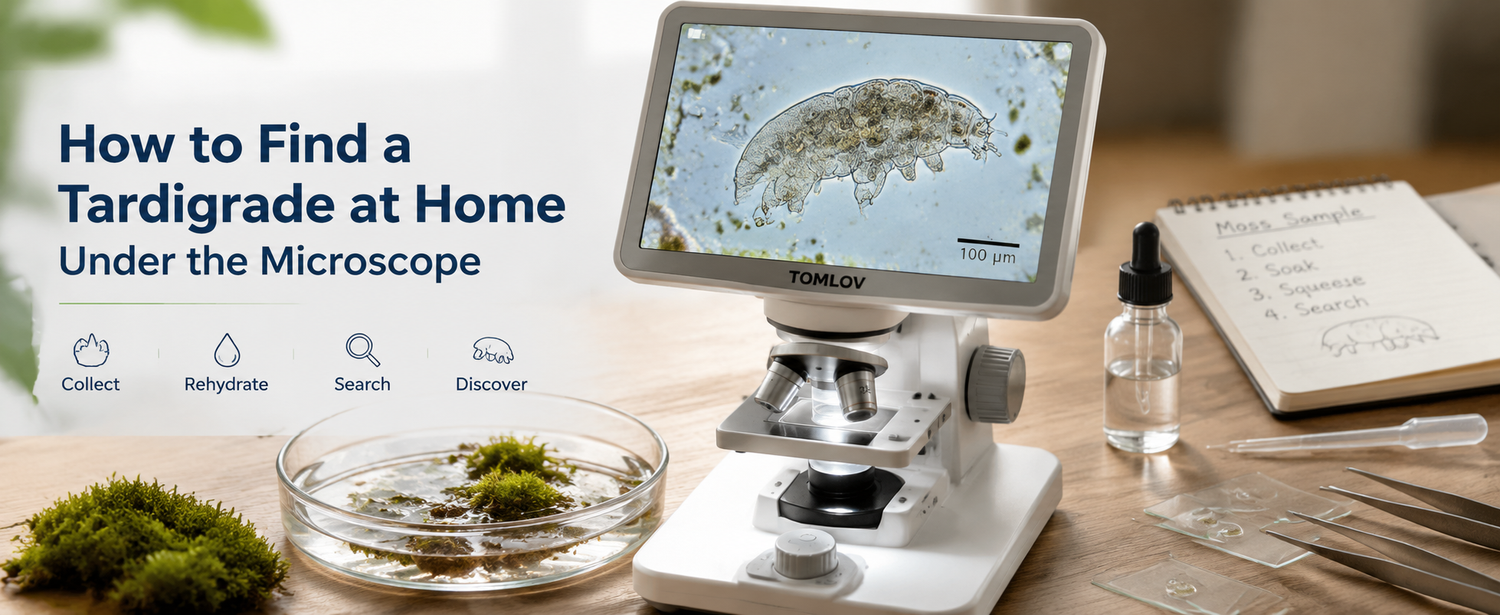
Tardigrades, also called water bears, are tiny animals with plump bodies and four pairs of legs. Most are well under 1 mm long, so finding one takes a little patience rather than a quick glance at a clump of moss. Collect a good sample, rehydrate it, squeeze out the trapped water, check small drops at low magnification, and move a suspected tardigrade to a cleaner slide for a closer look. This guide shows you how to collect, prepare, and search a sample step by step, then confirm what you found under the microscope.
|
Quick Start Step |
What to Do |
Key Tip |
|
1. Collect Moss or Lichen |
Take small samples from several clean spots on bark, stone, brick, or shaded walls. |
Try more than one sample because not every patch contains tardigrades. |
|
2. Soak and Squeeze |
Rehydrate the sample in shallow water for 3–24 hours, then squeeze it over a dish. |
Use rainwater, distilled water, spring water, or dechlorinated tap water. |
|
3. Transfer Small Drops |
Use a pipette to move water and fine debris from the dish onto separate slides. |
Avoid putting too much debris on one slide. |
|
4. Search and Confirm |
Start with the widest available view, then raise magnification after you spot movement. |
Look for a short, plump animal with four pairs of legs. |

Where Should You Look for Tardigrades?
Moss and lichen are reliable starting samples
Moss and lichen are good places to begin because they hold thin films of water around their surfaces. Tardigrades often live in these tiny wet spaces, even when the sample appears dry at first.
Collect a small amount from several locations rather than relying on one clump. Moss on bark, bricks, stone, or shaded walls can all be worth checking. Keep each sample separate so you can return to a more promising location later.
Leaf litter can also hold tiny water habitats
Leaf litter can also hold small water-rich spaces, especially beneath fallen leaves in damp areas. It is less predictable than moss or lichen, but it can be useful when you cannot find a good moss sample.
Avoid material that is heavily polluted, covered in road dust, or exposed to obvious chemicals. A cleaner sample is easier to inspect and less likely to contain distracting debris.
What Setup Makes a Home Search Easier?
A shallow dish gives you room to work
Use a Petri dish, watch glass, or another shallow clear container. The dish is not where you need to complete the whole search. Its job is to hold the moss while it rehydrates and to collect the water and debris released when you squeeze the sample.
A shallow container keeps the material easier to manage than a deep cup. After extraction, you can move only a few drops at a time onto slides for a more systematic check.
Low magnification helps you spot movement first
After squeezing the moss, let the water sit for a minute or two. Use a pipette to transfer a few small drops of water and fine debris from the bottom of the dish onto clean slides.
Check one drop at a time using the widest available view. At this stage, look for slow movement and a short, plump body. You are not trying to see tiny claws yet. Working through several small drops is usually easier than scanning one crowded slide full of moss fragments.
A slide-ready digital microscope helps you confirm details
For a simple one-microscope home workflow, choose a microscope for specimen observation that supports slide viewing, bottom illumination, stable focusing, and image capture.
This lets you use the same setup for both stages: first, scan several small drops for movement; then, raise magnification gradually after you find a likely tardigrade. Screen viewing can make it easier to adjust focus while following the animal’s body outline.
How Long Should You Soak the Sample?
Dry moss needs time to rehydrate
Place the moss or lichen in your shallow dish and add enough water to wet it thoroughly. For dry samples, allow roughly 3 to 24 hours before searching. This gives the sample time to absorb water and may allow dormant tardigrades to become active again.
If nothing seems to move after a few minutes, do not assume the sample is empty. Leave it longer, then return and search again.
Use clean water without fresh chlorine
Rainwater, distilled water, spring water, or tap water that has been left uncovered for about 24 hours are suitable choices. Avoid using freshly chlorinated tap water directly from the faucet.
Use only enough water to cover the sample. Too much water spreads debris too widely and makes the later transfer step less efficient.
How Do You Release Tardigrades from Moss?
Squeeze the sample over the dish
After soaking, lift the moss with tweezers and squeeze or press it firmly over a second shallow dish. Repeat this several times.
Tardigrades can stay caught among moss fragments, so gently swirling the sample is often not enough. Treat the moss like a sponge: the goal is to push trapped water, sediment, and small organisms into a clearer area where you can collect them.
Collect water and debris from the bottom
Let the squeezed water sit briefly. Fine debris tends to collect toward the bottom, which is where you should take your first pipette samples.
Avoid taking only clear surface water. The drops with fine particles and moss fragments are more likely to contain the small organisms you are trying to find.

How Do You Search a Slide for a Tardigrade?
Start with the widest available view
Place a small drop of extracted water on a clean slide. Start with the widest view your microscope provides so you can scan more area at once.
Beginning at very high magnification usually makes the search harder. You lose context, see less of the sample, and can spend too long inspecting ordinary debris.
Scan slowly around debris and moss fragments
Move across the slide in a simple pattern rather than jumping around randomly. Check around fine sediment, moss fragments, and small clusters of debris.
If you do not find anything after a careful search, prepare another slide from a different drop. Trying another part of the sample is often more useful than repeatedly increasing magnification on an empty slide.
Watch for slow movement and a plump body
Look for a short, rounded creature moving slowly on several stubby legs. Depending on the species and what it has eaten, it may appear translucent, pale, brownish, or slightly green.
Movement is often the best first clue. A grain of sand stays still. A tardigrade may crawl, stretch, turn, or slowly change direction.
How Do You Prepare a Cleaner Slide for Close Viewing?
Transfer the suspected tardigrade to a fresh drop
Once you spot a likely tardigrade, use a pipette to collect it with a small amount of surrounding water. Move it to a fresh slide with a cleaner drop of water.
This reduces the amount of moss and sediment around the animal, making its body outline and legs easier to see. Missing it on the first attempt is normal, so return to the original slide and try again if needed.
Add a cover slip without pressing down
Lower the cover slip from one side so air can escape gradually. Do not press it down, since that can flatten the animal or stop it from moving.
If the drop looks too shallow, remake the slide with slightly more water. Leaving some room beneath the cover slip is better than compressing the specimen.

What Features Help Confirm You Found One?
Four pairs of legs and tiny claws
A tardigrade has four pairs of legs. This is one of the clearest features that separates it from many other small organisms you may find in moss water. Each leg ends in small claws, although those claws can be difficult to see at low magnification.
First confirm the four pairs of legs, then raise magnification gradually if you want to inspect the leg tips more closely.
A short body and slow walking movement
Tardigrades have a short, plump body and a slow walking motion. Their scientific name, Tardigrada, means “slow stepper,” which fits the way they move across debris or a slide.
Their movement is usually slower and more deliberate than many other tiny organisms in a water sample. That slow, bear-like crawl is one of the easiest clues for beginners.
Higher magnification reveals more detail
After confirming the overall shape, raise the magnification gradually to inspect the legs, claws, and body outline. At this stage, screen viewing can make it easier to fine-tune focus while keeping the animal in view, and a saved image gives you something to compare later.
For this kind of close slide observation, the TOMLOV DM301 Pro digital microscope provides adjustable top and bottom lighting, three achromatic lenses, a 7-inch screen, slide accessories, and photo or video capture for documenting what you find.
Do not identify a tardigrade species from one quick image. Species-level work requires clearer views, detailed measurements, and specialist references.
Conclusion
Finding a tardigrade at home rewards patience more than extreme magnification. Start with moss or lichen, let it rehydrate, squeeze the trapped water into a shallow dish, and inspect several small drops on slides.
Once you spot a likely animal, transfer it to a cleaner slide and increase magnification gradually. The practical approach is simple: collect carefully, search wide, then inspect closely.
FAQs
Can You Buy a Tardigrade?
Sometimes. Some educational suppliers and hobby sellers offer live tardigrade cultures, though availability and shipping rules vary. For most beginners, collecting moss or lichen locally is simpler and creates a more natural observation project. Keep any culture contained and never release it outdoors.
Can a Tardigrade Be Killed?
Yes. Tardigrades are resilient, but they are not indestructible. Some can survive drying by entering a dormant state, but active tardigrades can die from prolonged heat, unsuitable water, physical damage, or lack of food. Their survival depends on the species and conditions.
Do Tardigrades Live on Your Face?
No. Tardigrades do not normally live on human skin or faces. They need water-rich habitats such as moss, lichen, soil, freshwater, or marine environments. A tardigrade could be moved briefly by contact with a sample, but it cannot establish a population on your face.
Are Tardigrades Self-Aware?
There is no evidence that tardigrades are self-aware. They can walk, respond to their surroundings, and enter dormant states, but these behaviors do not demonstrate self-recognition or conscious reflection. Their nervous systems are very small, and scientists have not shown that they have self-awareness.

Hinterlasse einen Kommentar
Alle Kommentare werden vor der Veröffentlichung geprüft.
Diese Website ist durch hCaptcha geschützt und es gelten die allgemeinen Geschäftsbedingungen und Datenschutzbestimmungen von hCaptcha.