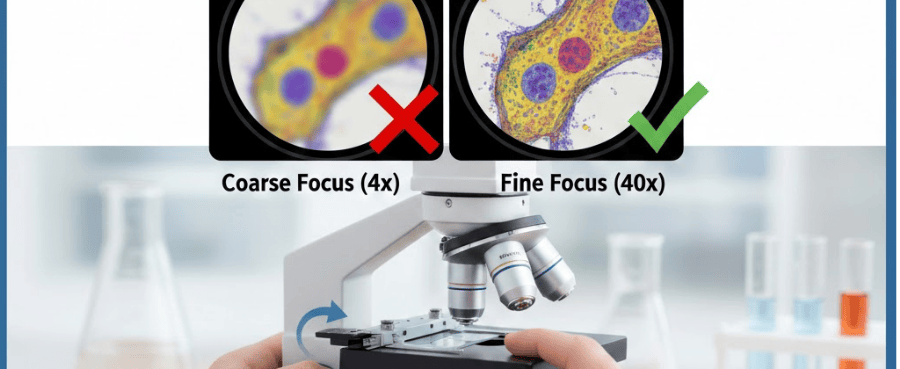
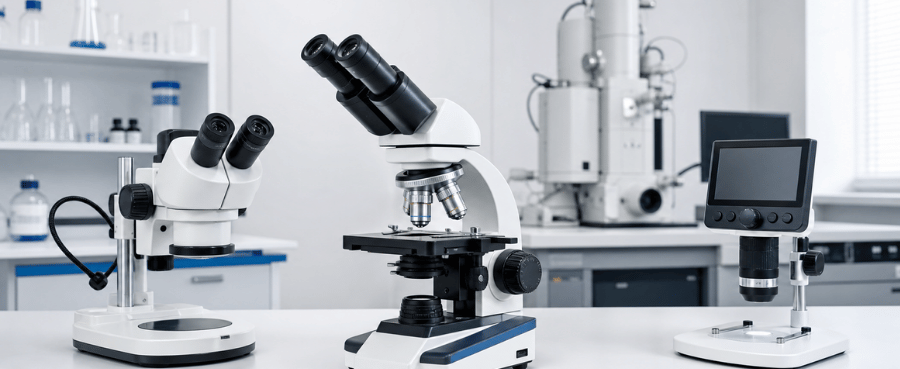
Microscope frustration often stems from selecting a microscope unsuited for the task. For example, a biology microscope excels at examining slides but is not suitable for solid 3D objects such as rocks or circuit boards. This is why a highly advertised “high magnification” microscope may appear impressive in marketing but fall short during actual use.
This guide explains the 9 main microscope types with real-life examples and helps you quickly choose the right one for your needs.
Before we dive in, here's a brief overview to quickly orient you to your options. This will set the stage for a closer look at each type, starting with the most relevant options for most beginners.
|
Microscope Type |
Best Used For (Samples) |
Key Feature / Mechanism |
Target User |
Price Range |
|
1. USB / Handheld Digital |
Surface Inspection
(Skin, leaves, fabrics, hobby checks) |
Portable; views directly on a phone/laptop screen (no eyepieces). |
Kids, Field Researchers, Casual Users |
($20 – $100) |
|
2. Stereo
(Dissecting) |
3D Opaque Objects
(Coins, bugs, circuit boards, rocks) |
Provides 3D depth perception; large working distance for hands/tools. |
Hobbyists, Repair Technicians, Coin Collectors |
($150 – $600) |
|
3. Compound
(Biological) |
Transparent Slides
(Cells, bacteria, blood, pond water) |
High magnification (40x–1000x) using light passing through the sample. |
Students, Schools, Medical Labs |
($200 – $1,000) |
|
4. Inverted |
Living Cells in Liquid
(Petri dishes, culture flasks) |
Objectives are placed under the stage to view liquids without dipping the lens. |
Cell Biologists, Fertility Clinics (IVF) |
($1,500+) |
|
5.Metallurgical |
High-Mag Opaque Solids
(Metal grain, ceramics, plastics) |
High magnification using reflected light (bounces off the sample surface). |
Industrial Manufacturers, Engineers |
($1,000 – $5,000+) |
|
6. Polarizing |
Minerals & Chemicals
(Rock thin sections, crystals) |
Uses polarized filters to make minerals glow in specific colors for identification. |
Geologists, Pharmaceutical Labs |
($2,000+) |
|
7.Fluorescence |
Specific Cell Structures
(Tagged proteins, DNA, antibodies) |
Uses UV light and glowing dyes to highlight specific parts of a specimen. |
Advanced Medical Research |
($5,000 – $20,000+) |
|
8. Confocal |
3D Cell Reconstruction
(Thick tissue samples) |
Uses lasers to scan a sample layer-by-layer to build a sharp 3D model. |
Biomedical Imaging Centers |
($30,000+) |
|
9. Electron
|
Nanoscale Objects
(Viruses, atoms, nano-materials) |
Uses electron beams instead of light. The only way to see viruses. |
Top-tier Research Universities |
($50,000 – $1M+) |
The "Big Three" for Beginners & Hobbyists (Start Here)
For students, parents, and home hobbyists, your search should almost certainly start and end with one of these three types. These cover 99% of home and school use cases.
Stereo Microscopes (The "3D Object" Viewer)
Also known as a "Dissecting Microscope," this type of microscope is popular among hobbyists. Unlike high-power laboratory microscopes, stereo microscopes use two separate optical paths (meaning they have separate sets of lenses for each eye), which creates a three-dimensional (3D) image so you can see depth.

How it Works: Instead of transmitting light through the object (as some microscopes do), a stereo microscope shines light onto the surface of the object and then reflects it up to your eyes. This method is called reflected light illumination. It means you don't need to cut your sample thin. You can simply place items like a rock, a flower, or a watch part under the lens and observe them as they are.
Magnification Range: Low (typically 10x to 40x). Note: You don't need high zoom to see the date on a penny or the legs of a spider.
-
Best For:
- Hobbyists: Coin collecting, watch repair, jewelry making.
- Electronics: Soldering and inspecting PCBs (Printed Circuit Boards).
- Kids: Looking at bugs, dirt, and leaves without complex preparation.
-
Price Check: $$ ($150 - $600 for quality models).
Pro Tip: Look for "Zoom Stereo" models rather than "Fixed Power." This allows you to smoothly zoom in and out without losing focus, which is critical when working with your hands under the lens.
Related Reading:How to Choose Your First Digital Microscope
Compound Microscopes (The "Slide" Viewer)
When you picture a "microscope" in a science classroom, this is it. The Compound Microscope is designed for high-magnification views of transparent specimens.
- How it Works: Compound microscopes use transmitted light, meaning light shines up through the object from beneath the stage (the platform where you place the slide). For light to pass through, the sample must be thin and transparent. You cannot view solid or opaque things. Instead, you create slides with thin slices of material between glass pieces, called coverslips.
- Magnification Range: High (40x to 1000x).
- Best For:
- Biology Students: Viewing plant cells, bacteria, and blood cells.
- Pond Water: Watching protozoa and algae swim.
- Veterinary/Medical: Parasite checks and basic pathology.
-
Price Check: $$ ($200 - $1,000).
USB & Handheld Digital Microscopes (The "Fun & Portable" Choice)
This is a rapidly growing category. These devices skip the eyepieces entirely and send the image directly to your laptop, tablet, or smartphone.
- How it Works: These devices are macro cameras, which are cameras designed to focus on very small objects placed close to the lens. Digital microscopes send the image to your device screen. They are highly portable and let groups view images together, though they usually cannot match the detailed resolution (sharpness and detail) provided by microscopes with glass lenses.
- Magnification: Variable (Magnification: Variable (often advertised as “1000x,” but for most coin usb microscope use cases, the clearest results are realistically around 50x–200x).
- Best For:
- Field Trips: Checking plant health in the garden.
- Skin/Scalp Analysis: Quick cosmetic checks.
- Casual QC: Checking a knife edge or a fabric weave.
-
Price Check: $ ($20 - $100).
-
A $30 USB microscope is suitable for general exploration, but it does not display bacteria. For viewing cellular detail, use a Compound microscope.
Related Reading:How To Use A Digital Microscope

Specialized Optical Microscopes (For Specific Jobs)
If you have a specific industrial or scientific need, the standard "Big Three" might not cut it. These microscopes are modified for specific materials.
Inverted Microscopes
Imagine a standard biological microscope turned upside down.
- The Problem: A normal microscope lens gets too close to the sample. For growing cells in a liquid flask, a standard lens hits the liquid.
- The Solution: The objectives are placed under the stage, looking up. This allows you to view huge Petri dishes or flasks without disturbing the liquid.
- Primary Use: Tissue culture, IVF (In-Vitro Fertilization), and observing living organisms in large containers.
Metallurgical Microscopes
- The Problem it Solves: You need high magnification (like a compound scope) to see microscopic cracks or grain structures, but your sample is opaque (like a chunk of steel).
- The Solution: Metallurgical microscopes use a high-power lens system with epi-illumination. Epi-illumination is a technique where light shines down through the microscope's lens onto the surface of the metal and then bounces back up into the lens to reach your eye, allowing you to view opaque samples.
- Primary Use: Industrial inspection of metals, ceramics, plastics, and wafer fabrication.
Polarizing Microscopes
- The Problem it Solves: Many chemicals and minerals look clear/white under normal light. It's hard to tell them apart.
- The Solution: These microscopes use two filters called a polarizer and an analyzer to cross-polarize light. Cross-polarizing means the filters let through only certain light orientations. Materials that are birefringent (meaning they can split light into two beams) will interact with this light and glow in bright, colorful patterns, revealing their inner crystal structure.
- Primary Use: Geology (identifying rock minerals), Toxicology, and Pharmaceutical testing.

Related Reading:Digital vs. Optical Microscopes: An In-Depth Comparison
Advanced Research & Medical Types (High Budget)
These are the heavy hitters found in universities and hospitals. While you likely won't buy one for your home, it is important to know what they do so you don't expect their results from a $200 device.
Fluorescence Microscopes
If you have observed images of neurons or cancer cells illuminated in distinct colors, you were looking at fluorescence microscopy.
- How it Works: In fluorescence microscopy, samples are stained with special dyes called fluorophores. These are molecules that glow when exposed to specific wavelengths of light (such as ultraviolet, or UV). The microscope shines a specific type of light on the sample, causing the fluorophore dye to emit a different color light that can be seen and recorded.
- Why it Matters: It allows scientists to tag specific proteins or DNA sequences to see exactly where they are in a cell.
Electron Microscopes (SEM / TEM)
This is the "theoretical ceiling" of microscopy.
- The Reality: Electron microscopes use electron beams, not light, to reveal tiny details like viruses, DNA, and atoms.
- These models are expensive, require a vacuum chamber, and fill a small room. You can't use a home microscope to see viruses.
- Primary Use: Nanotechnology, virology, and high-end materials science.
Confocal Microscopes
These are laser-based microscope systems that use a focused beam of light to scan a biological sample layer by layer. By collecting sharp images of each thin slice, these systems can create a three-dimensional (3D) reconstruction—that is, a computer model showing the cell’s shape and structure. This scanning process is called optical sectioning and eliminates the blur seen in standard images.

Quick Guide: Which Microscope Do I Need?
- 1. Ask yourself: "Can light pass through my sample?"
- NO (It is solid/opaque like a rock, bug, coin, or circuit board):
- Best Choice: Stereo Microscope. It gives you a 3D view and room to work with your hands.
- Budget/Casual Choice: USB Digital Microscope. Great for quick checks on a screen, but lower quality.
- YES (It is transparent like a cell, bacteria, blood, or pond water):
- Best Choice: Compound Microscope. You must put the sample on a glass slide. This is the standard "biology class" microscope.
- 2. Specialized Scenarios:
- Living cells in a liquid dish? → Inverted Microscope.
- High-power inspection of solid metal/plastic? → Metallurgical Microscope.
- Identifying rock minerals? → Polarizing Microscope.
The Golden Rule: Don't buy a Compound Microscope to look at rocks, and don't buy a Stereo Microscope to look at bacteria. Match the tool to the sample!
Conclusion
Navigating the world of microscopes doesn't have to be a guessing game. While the technology behind an Electron Microscope or a Confocal system is mind-blowing, the decision for most of us usually falls into the "Big Three":
- Go Digital (USB) if you want portable fun and quick snapshots.
- Go Stereo if you want to work with your hands and look at 3D objects like bugs, rocks, or circuits.
- Go Compound if you want to explore the invisible world of cells and bacteria on prepared slides.
The best microscope is not determined by the highest magnification but by its suitability for your sample. Instead of focusing on “2000x zoom” claims, prioritize quality lenses and proper illumination.
The microscopic world is ready to be explored. With an understanding of microscope differences, you can make informed choices and begin investigating. Happy viewing.
Frequently Asked Questions (FAQs)
1. Can I see viruses with a regular microscope?
No. Viruses are too small to be resolved by light waves. Even the most expensive hospital optical microscope cannot see them. You would need an Electron Microscope for that. You can, however, see bacteria, which are much larger.
2. I see microscopes advertised as "2000x" or "5000x" zoom. Are they better?
Usually, no. This is often called "empty magnification." A standard compound microscope typically achieves up to 1000x usable resolution, meaning the highest amount of detail you can clearly see. Anything higher usually just makes the image blurrier, similar to zooming in too far on a digital photo and losing sharpness. Prioritize lens quality (look for "DIN Achromatic objectives," which are standardized lenses with improved image clarity) over extra-high zoom numbers.
3. Do I need a "Darkfield" microscope to see live blood?
Not necessarily a whole new microscope. Darkfield is a technique where a special filter blocks most of the light except what is scattered by the sample, making the sample appear bright against a dark background. You can often buy a "Darkfield Stop" (a small filter) for a standard compound microscope that allows you to perform this technique for a fraction of the cost.
4. Can I use a Compound microscope to look at rocks?
No. The light comes from the bottom. Since rocks don't let light through, you will see a black silhouette. You need a Stereo microscope for rocks.
5. Glass vs. Plastic lenses: Does it matter?
Yes. For any serious learning or hobby work, always ensure the optics are glass. Plastic lenses (found in toy kits) scratch easily and provide cloudy images, which leads to frustration and the microscope gathering dust.


Leave a comment
All comments are moderated before being published.
This site is protected by hCaptcha and the hCaptcha Privacy Policy and Terms of Service apply.