
Table of Contents
If your kid just got a biology class supply list and "microscope" is on it, you're probably staring at a wall of options online wondering where to start. Compound? Stereo? Digital? What does any of that even mean?
Don't worry. This guide breaks it all down in plain English so you can pick the right microscope without buying something the teacher will reject on day one.
Most Students Need a Compound Light Microscope
For standard middle school, high school, and introductory college biology classes, a compound light microscope is what students need. This is the classic microscope you picture when someone says the word: a tube with an eyepiece on top, a stage in the middle where you place your slide, and a light source at the bottom.
Compound microscopes are designed to look at very thin, flat specimens like onion cells, cheek cells, or pond water samples. They magnify objects from 40x up to 400x or even 1000x in more advanced models. That range covers pretty much everything a biology student will encounter from 6th grade through a college intro lab.

What Grade Level Are We Talking About?
The right microscope depends a lot on where your student is in school.
Middle School (Grades 6–8)
At this level, students are just getting introduced to cell structure and basic microscopy. A microscope with 40x, 100x, and 400x magnification is more than enough. Durability matters here too, since middle schoolers aren't always the most careful with equipment. Entry-level compound microscopes work well at this stage.
High School (Grades 9–12)
High school biology gets more detailed. Students start working with prepared slides, doing labs on mitosis, and possibly examining bacteria. A compound microscope with solid optics and a reliable mechanical stage — the platform that lets you move your slide in small increments — will serve them well through AP Biology and beyond. This is also the stage where some students start exploring a digital microscope for at-home projects or science fair work, since being able to display live images on a screen makes it easier to document findings and share results.
College Introductory Courses
Most college bio labs provide microscopes, so buying one isn't usually necessary unless your student wants one for studying at home. If they do want their own, look for something with at least 1000x magnification and a built-in mechanical stage.
Key Features to Look For
You don't need to become a microscopy expert to make a good purchase. Focus on these few things.
Magnification Range
A good student microscope should have at least three objective lenses: 4x, 10x, and 40x. Combined with a 10x eyepiece, that gives you 40x, 100x, and 400x total magnification. Some models also include a 100x oil immersion lens for 1000x magnification, which is useful for high school AP classes and college courses.
Optical Quality
This is where lower-end microscopes often cut corners. Look for "achromatic" lenses, which correct for color distortion and give you a much clearer image. Avoid toy microscopes with plastic lenses, as the image quality is noticeably worse and genuinely frustrating to work with during a timed lab.
Light Source
LED lighting has replaced older incandescent bulbs in most modern microscopes, and that's a good thing. LEDs last longer, run cooler, and give more consistent output. Make sure the brightness is adjustable, which helps when switching between stained slides and unstained samples.
Build Quality
A full metal body is worth it. Plastic microscopes feel shaky and don't hold focus as well. Metal bodies are more stable, which matters a lot when you're trying to dial in on something at high magnification.
Coarse and Fine Focus Knobs
Both are important. The coarse knob brings your specimen into rough focus quickly. The fine focus knob lets you dial it in precisely. Some very basic microscopes skip the fine focus adjustment entirely, which makes lab work a lot harder than it needs to be.
How Much Should You Spend?
Without getting into specific numbers, the general rule is this: entry-level is fine for middle school, mid-range is better for high school, and anything marketed as a toy or priced suspiciously low is worth skipping regardless of grade level.
Matching Budget to Grade Level
Think about it in terms of what you're actually getting. At the lower end of the student market, you can find decent compound microscopes with LED lighting and metal bodies that handle everyday biology labs without trouble. Move up a tier and you get better optics, a mechanical stage, and more durable construction — worth it for high school students who will be using the scope regularly. For AP Biology or college-level work, a better model pays off through more reliable optics and features like a binocular eyepiece, which reduces eye strain during longer lab sessions.
A Note on Digital Microscopes and Budget
One area where it's worth comparing options more carefully is if your student is interested in a digital microscope for home use. Digital models vary quite a bit in quality, and what you get at each tier differs more noticeably than it does with traditional compound microscopes. It's worth reading reviews closely and checking what software comes included before making a decision.

Do Students Ever Need a Different Type of Microscope?
Most of the time, no. But here are a few situations where another type comes into play.
Stereo Microscopes
These are used to look at whole objects in 3D rather than thin slides — things like insects, flowers, rocks, or dissection specimens. Some advanced high school and middle school science fairs involve stereo microscopes, but they're rarely required for standard biology class. If your student is into entomology or botany as a hobby, a stereo microscope is a nice addition, though it won't replace a compound microscope for coursework.
Digital Microscopes
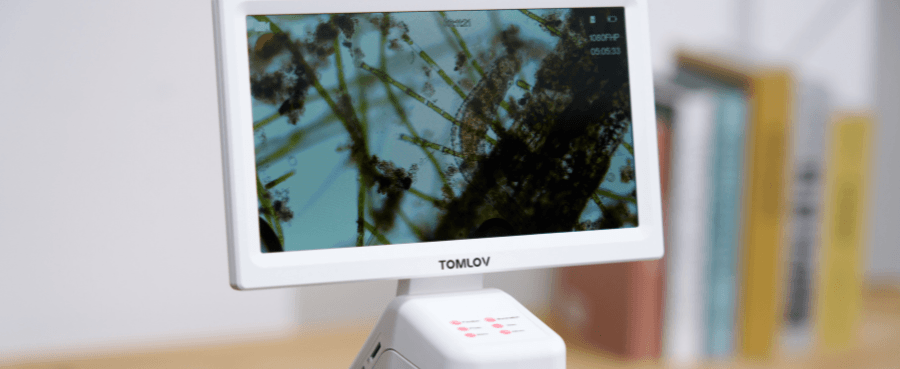
A digital microscope connects to a computer or tablet and displays the image on a screen rather than through an eyepiece. That setup has some real advantages for students. It's easier on the eyes during long sessions, it makes it simple to capture photos or record video of specimens, and it's more accessible for younger kids who struggle to peer through a traditional eyepiece.
Digital microscopes are especially useful for home science projects, science fairs, and independent study. If your student is working on a project that involves documenting specimens over time or presenting observations to a class, a digital microscope makes that process a lot more straightforward. Some models also come with built-in software that lets students measure, annotate, and compare images, which is genuinely handy for project write-ups.
That said, most schools still use traditional eyepiece-based microscopes in their labs, so a digital microscope works best as a complement to a compound microscope rather than a replacement for one.
Related Reading: Choosing the Right Microscope: A Complete Guide for Beginners
Should You Buy or Borrow?
Check With the Teacher First
Many schools provide microscopes for in-class labs, so students don't always need to bring their own. Before buying anything, check with the teacher or look over the class syllabus. Some programs specifically ask students to have their own microscope, while others cover it entirely in the school lab.
When Buying Makes Sense
If your student frequently does at-home lab work, or if they're genuinely interested in science and want to keep exploring outside of class, owning a personal microscope makes sense. A digital microscope can be a good fit here too, especially for students who want to photograph or record their observations rather than just look through a lens and move on.
Final Thoughts
For most biology students, a compound light microscope with achromatic lenses, LED lighting, a metal body, and magnification up to 400x is the right starting point. Check with the teacher before buying anything, match the microscope to the grade level, and skip anything marketed as a toy.
If your student wants something for home projects or science fair work, a digital microscope is worth a serious look. It won't cover everything a biology class requires, but for hands-on exploration and documenting specimens, it's a genuinely useful tool to have around.
Biology class is often where students first get hooked on science. Having equipment that actually works makes that experience a whole lot better.

Leave a comment
All comments are moderated before being published.
This site is protected by hCaptcha and the hCaptcha Privacy Policy and Terms of Service apply.