
Table of Contents
If you work with jewelry professionally or as a serious hobbyist, you already know that a lot of the most important details are invisible to the naked eye. Prong wear, stone inclusions, hairline cracks in settings, solder quality — these things only show up clearly under magnification. The right microscope makes that work faster, more accurate, and a lot less frustrating.
But "the right microscope" means different things depending on how you use it. A bench jeweler doing repairs every day has different needs than a gemologist grading stones or a hobbyist checking their own pieces at home. This guide walks through what actually matters when choosing a microscope for jewelry work, so you can skip the features that don't apply and focus on the ones that do.
Why a Regular Magnifier Isn't Enough
The Limits of Loupes and Hand Lenses
A 10x loupe is the industry standard for a reason — it's portable, quick, and gives you a clean view of surface inclusions. But it has real limits. You can only hold it steady for so long, your hands are always in the way, and anything that requires both hands free (like setting a stone or doing delicate repair work) becomes awkward fast.
What a Microscope Adds
A microscope solves those problems by giving you a stable, hands-free view with consistent lighting. You can work under magnification rather than just look under it. That's a meaningful difference for anyone doing bench work, engraving, stone setting, or detailed inspection. A good jewelry microscope also gives you a wider range of magnification than a loupe, so you can zoom out to check overall proportions and zoom in to examine fine details without swapping tools.
Types of Microscopes Used for Jewelry
Stereo Microscopes
The stereo microscope is the most common choice for jewelry work, and for good reason. It gives you a three-dimensional view of the piece, which matters when you're working with depth — looking into a bezel setting, examining a pavé row, or checking whether a prong is flush. Most stereo microscopes used in jewelry sit in the 10x to 45x range, which covers everything from overall setting inspection to close-up gemstone work.
Stereo microscopes also have a useful working distance, meaning there's enough space between the lens and your work surface to actually maneuver tools. That's not something every microscope type offers.
Gemological Microscopes
These are a step up from standard stereo scopes. Gemological microscopes are built specifically for stone grading and include features like darkfield illumination, which lights the stone from the sides to reveal internal clarity characteristics without surface glare. If you're doing formal grading work or buying and selling stones, a gemological microscope is worth the investment.
Digital Microscopes
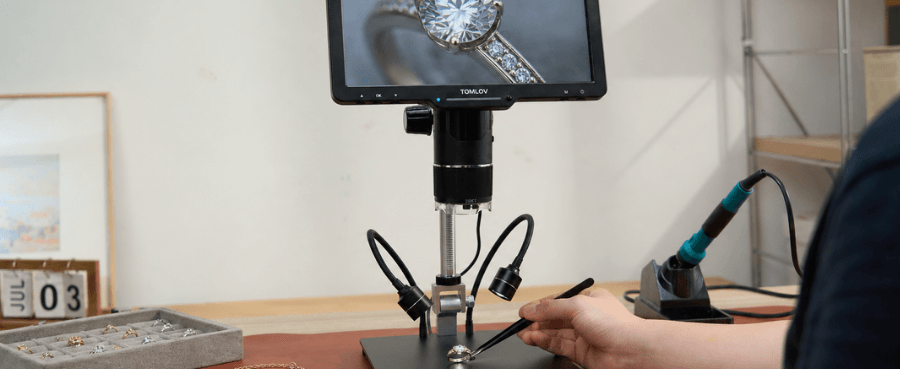
A digital microscope takes a different approach entirely. Instead of looking through an eyepiece, you view the image on a screen — a monitor, laptop, or tablet. That might sound like a trade-off, but for jewelry inspection it has some real practical advantages.
First, it's much easier on your neck and eyes. Traditional microscopes require you to lean into the eyepiece for extended periods, which adds up over a full workday. A digital microscope lets you sit back and work at a comfortable angle. Second, documentation becomes effortless. You can capture photos and video of every piece you inspect, which is useful for customer records, insurance documentation, repair sign-off, and quality control. Third, if you're working with a team or training someone, everyone can see the same image on screen at the same time.
The trade-off is that digital microscopes typically don't give the same true 3D view as a stereo scope, and the image quality depends heavily on the camera resolution and software. For dedicated bench work, many jewelers use both: a stereo scope for hands-on tasks and a digital microscope for inspection, documentation, and client consultations.
Related Reading: Digital vs. Optical Microscopes: An In-Depth Comparison

Key Features to Look For
Magnification Range
For jewelry, a magnification range of 10x to 45x covers most everyday needs. Lower magnification (10x to 20x) is useful for checking overall craftsmanship, setting alignment, and finish quality. Higher magnification (30x to 45x) is where you examine stone inclusions, inspect solder joints closely, and check prong tips for wear.
If you're doing gemological work and need to see internal characteristics at higher detail, look for models that go up to 60x or pair with additional lenses.
Working Distance
Working distance is the gap between the bottom of the objective lens and the surface of your work. For jewelry, you want at least 3 to 4 inches of clearance so you can move tools, tweezers, and your hands freely under the lens. Some microscopes marketed for jewelry have surprisingly short working distances, which makes actual bench work difficult. Always check this spec before buying.
Lighting System
Lighting makes or breaks a jewelry microscope. The two main types are:
Top lighting (reflected light): Shines down on the surface of the piece. Good for examining metalwork, finish, prong tips, and surface details.
Bottom lighting (transmitted light): Shines up through the piece. Useful for examining transparent or translucent stones for inclusions and clarity.
Darkfield illumination: Lights the stone from the sides, reducing surface reflection and making internal characteristics much easier to see. This is standard on gemological microscopes and genuinely worth having if stone grading is part of your work.
LED lighting is the current standard and the right choice. It runs cool, doesn't fade stones or adhesives over time, and gives consistent color temperature. Adjustable brightness is a feature worth prioritizing.
Zoom Type: Continuous vs. Fixed Steps
Continuous zoom lets you smoothly adjust magnification as you work. Fixed-step scopes snap between preset magnification levels. For jewelry inspection, continuous zoom is almost always more useful. You want to be able to dial in exactly the right magnification for what you're looking at, not jump between 10x and 20x with nothing in between.
Binocular vs. Trinocular Head
A binocular head has two eyepieces and is standard for most jewelry work. A trinocular head adds a third port for attaching a camera. If documentation is important to your workflow, a trinocular head gives you cleaner image capture than adapting a camera to a binocular scope.
That said, if you're leaning toward a digital microscope, the camera is already built in, so the trinocular consideration doesn't apply.
Related Reading: What To Look For In A Digital Microscope?

What to Think About Based on How You Work
For Bench Jewelers and Repair Shops
Prioritize a stereo microscope with a long working distance, continuous zoom, and good top lighting. You'll be spending hours under the scope, so ergonomics matter too. Look for an adjustable stand that lets you position the scope comfortably without hunching.
For Gemologists and Appraisers
A gemological microscope with darkfield illumination and transmitted light is worth the investment. Accurate stone grading depends on being able to see internal characteristics clearly, and the lighting system on a standard stereo scope won't always get you there.
For Retail Jewelers and Client-Facing Work
This is where a digital microscope really earns its place. Being able to show a customer exactly what you're seeing — a prong that needs attention, a scratch on a stone, or the quality of a setting — builds trust and makes conversations easier. Paired with photo documentation, it also creates a clear record of a piece's condition before and after service.
For Hobbyists and Home Use
You don't need a full professional setup to get real value from a microscope. A basic stereo microscope or a good digital microscope gives you a solid view of your own pieces, helps you learn to read gemstone quality, and makes small repair work much more manageable.
Features That Sound Useful But Often Aren't
A few things show up in product listings that look appealing but don't add much for jewelry-specific work:
Very high magnification claims: A microscope marketed as "up to 200x" might technically reach that level, but at 200x the depth of field and working distance are so limited that it's not useful for jewelry. Stick to scopes designed for the 10x to 60x range.
Built-in measurement software: Some digital scopes include measurement tools in their software. For gemology this can be handy, but for most bench work it's rarely used. Don't pay extra for it unless you have a specific need.
Excessive accessory bundles: Extra slide trays, specimen boxes, and prepared slides are useful for biology. For jewelry inspection, you won't use most of it.
Final Thoughts
The best microscope for jewelry inspection is one that fits how you actually work. For hands-on bench work, a stereo microscope with a long working distance and good lighting is the right foundation. For gemological grading, add darkfield illumination. For documentation, client consultations, or a more ergonomic setup, a digital microscope is genuinely worth considering, either as your primary tool or alongside a traditional scope.
Focus on magnification range, working distance, and lighting before anything else. Get those three right and most other features will fall into place.

Leave a comment
All comments are moderated before being published.
This site is protected by hCaptcha and the hCaptcha Privacy Policy and Terms of Service apply.