
Table of Contents
Observing salt crystals under a microscope reveals a fascinating geometric world hidden in plain sight. This guide explores the cubic structure of sodium chloride, explains how to properly prepare and view samples, and compares the microscopic differences between various types of household salt.
What Salt Looks Like Under a Microscope
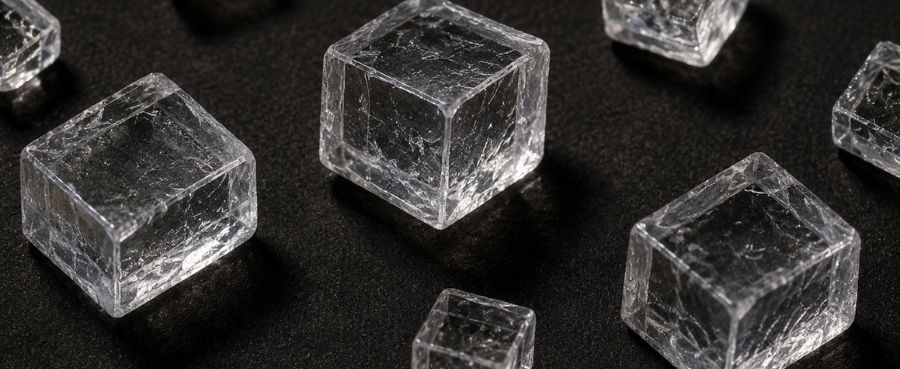
When viewed closely, standard salt reveals an incredibly structured and organized geometric shape. It does not look like random dust or dirt; instead, it looks like a collection of tiny, precise building blocks.
Cube-Like Crystal Shapes
The most striking feature of salt under a microscope is its cubic form. If you look at an untouched, perfectly formed grain, it looks exactly like a microscopic six-sided die. Every face is a square, meeting the adjacent faces at perfect 90-degree angles.
Sharp Edges and Flat Surfaces
Because of its crystalline nature, salt features incredibly straight edges. The flat surfaces, known as cleavage planes, are highly uniform. When a crystal breaks, it tends to fracture cleanly along these planes, creating smaller cubes or rectangular fragments rather than jagged, unpredictable shards.
Clear and Reflective Appearance
Under bright light, pure salt crystals are highly transparent. They exhibit a glassy, reflective quality known as a vitreous luster. The flat faces bounce light back into the camera lens, often creating bright highlights on the edges of the cubes.
Why Salt Crystals Have a Cubic Shape
The geometric perfection you see under the lens is a direct physical reflection of how the molecules arrange themselves at the atomic level.

The Structure of Sodium Chloride
Salt is chemically composed of sodium and chloride ions. Because of their opposite electrical charges, these ions attract each other and lock together in a repeating, tightly packed three-dimensional grid. This atomic lattice forms a perfect cube. The large square shape you see under the microscope is simply billions of these microscopic atomic cubes stacked together perfectly.
Why Real Grains Look Irregular
While the underlying structure is cubic, the salt sitting in your shaker has been heavily processed, crushed, and transported. This mechanical friction breaks the perfect cubes into smaller pieces. While you will still see 90-degree angles and flat faces, many grains will look like chipped blocks or rectangular prisms rather than flawless cubes.
How to Observe Salt Under a Microscope
Salt is one of the easiest and most rewarding subjects for beginners to inspect. You do not need complex dyes or wet mounts to see its structure.
Prepare a Small Salt Sample
Scatter just a few grains of salt onto a dry, clean glass slide or a dark piece of paper. Do not pile the salt up; keeping the grains separated makes it much easier to focus on a single crystal and observe its distinct edges.
Start With Low Magnification
Always begin with your lowest magnification setting. Because salt grains are relatively large (about 0.3 millimeters wide), a wide field of view allows you to locate the best-formed crystals before zooming in for closer inspection.
Adjust Focus and Lighting
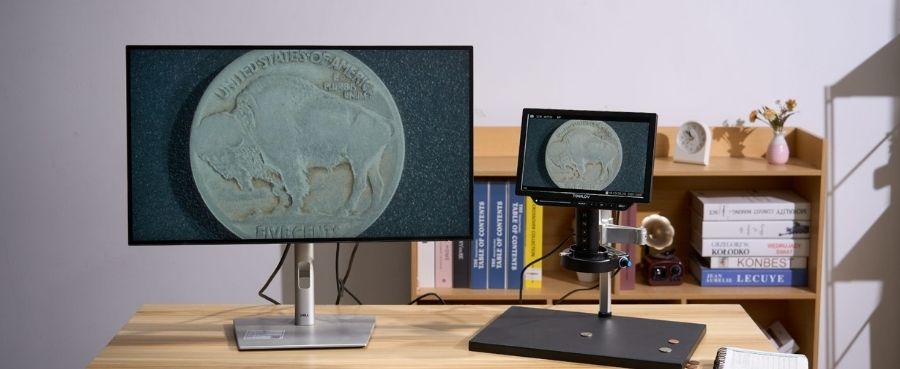
Direct overhead lighting can wash out the transparent crystals, making them look like flat white blobs. Use angled top lighting or side lighting to cast tiny shadows across the facets. A device with highly adjustable illumination, like Tomlov 3D Digital Microscope, allows you to angle the light perfectly to highlight the sharp geometric edges and observe the 3D structure of the grains without overwhelming the camera sensor.
Best Magnification for Viewing Salt Crystals
You do not need extreme laboratory-level power to enjoy the geometry of sodium chloride.
Low Magnification for Overall Shape
A magnification between 20x and 40x is ideal for seeing the overall cube shape. At this level, an entire grain fills the screen nicely, allowing you to appreciate the 90-degree corners and the general transparent blocky structure.
Higher Magnification for Surface Detail
Increasing the magnification to 100x or 200x allows you to explore the topography of a single crystal face. You will be able to spot microscopic scratches, tiny trapped air bubbles, and minor structural imperfections that occurred while the crystal was forming.
Different Types of Salt Under a Microscope
Not all salt looks identical. The specific mining or evaporation process leaves unique visual signatures on the final product.
Table Salt
Standard table salt is highly refined. It is typically crushed to a uniform size for easy pouring, meaning you will see a lot of broken cubes and rectangular fragments of roughly the exact same size.
Sea Salt
Sea salt is formed through the rapid evaporation of seawater. Under the lens, these grains are much more irregular, chunky, and flake-like. Because they form quickly and contain trace minerals, they often lack the perfect, flawless cubic structure seen in slower-forming salts.
Himalayan Pink Salt
Mined from ancient sea beds, Himalayan salt contains trace amounts of iron oxide (rust) and other minerals. Under a microscope, these impurities give the crystals a distinct reddish-pink tint. They often look like jagged, unrefined rock fragments rather than clean, transparent cubes.
Salt Compared With Sugar Under a Microscope
To the naked eye, salt and white sugar look like identical white powders. Under a microscope, their structural differences become instantly obvious.
Differences in Crystal Shape
While salt is built on a cubic structure, sucrose (sugar) is monoclinic. Sugar crystals look like hexagonal or oblong pillars with distinctly slanted, chisel-like ends. You will never see a perfect 90-degree square corner on a pure sugar crystal.
Why Microscopy Helps With Comparison
The easiest way to tell the two apart without tasting them is simply to place them under a lens. The stark contrast between the boxy, square shapes of sodium chloride and the long, slanted prisms of sucrose is a perfect demonstration of how molecular chemistry dictates physical shape.
Final Thoughts
Looking at salt under a microscope is a fantastic way to bridge the gap between chemistry and the physical world. By taking a few moments to properly light and magnify these common grains, you can easily observe the perfect cubic lattice of sodium chloride. Whether you are comparing sea salt to table salt or contrasting salt against sugar, 3D digital microscope turns a basic kitchen staple into an incredible geometric display.

Frequently Asked Problems
What Happens to Salt Under a Microscope When You Add Water?
Salt crystals gradually dissolve as water separates the sodium and chloride ions from the crystal. Under magnification, you may see the sharp edges become smaller and less defined until the visible crystal completely disappears into the liquid.
Does Iodized Salt Look Different From Non-Iodized Salt Under a Microscope?
Usually, the difference is incredibly difficult to identify visually with a standard microscope. Both are primarily sodium chloride, and the microscopic amount of iodine added to iodized salt generally does not create an obvious physical difference on the crystal's surface.
Can Salt Crystals Damage a Microscope?
Loose salt grains can scratch optical surfaces or leave corrosive residue if they contact sensitive microscope components. Keep the sample contained on a glass slide, avoid bringing the objective lens into physical contact with the crystals, and clean the stage thoroughly after observation.
Does Salt Change Shape When It Recrystallizes?
It can. Salt dissolved in water and allowed to crystallize again slowly may produce much more clearly defined geometric cubes than crushed commercial table salt, although the final appearance depends heavily on the evaporation conditions and the speed of crystal growth.

Leave a comment
All comments are moderated before being published.
This site is protected by hCaptcha and the hCaptcha Privacy Policy and Terms of Service apply.